Best Puppy Food for Blue Heeler Puppies
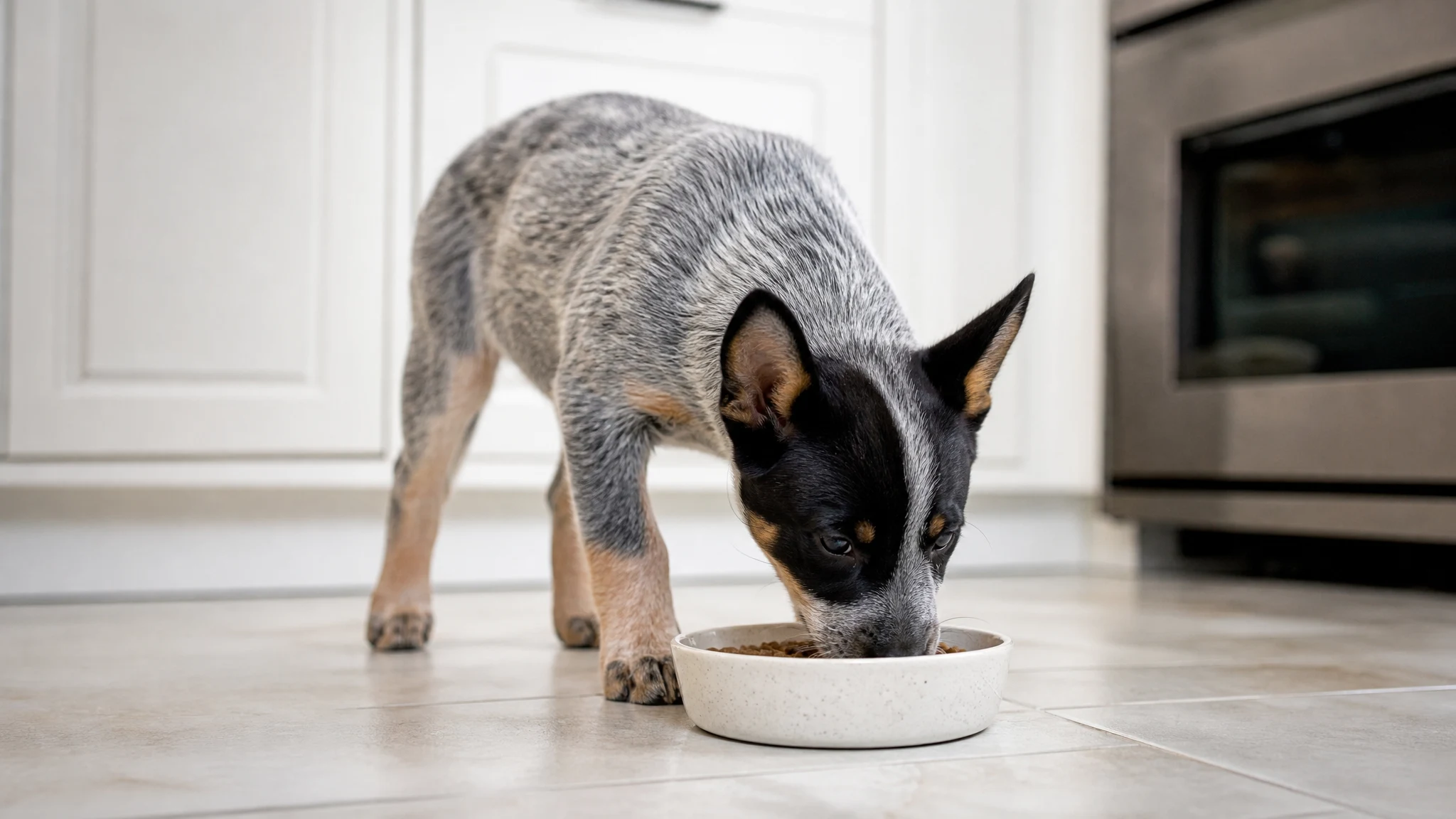
General nutrition information compiled from product labels and published sources, not veterinary advice. Your veterinarian is the right person to choose a diet for your dog, especially one with a health condition.
Picking the best puppy food for Blue Heelers is mostly a label-reading job. Marketing on the front of the bag tells you little. The small print on the back tells you much more.
This guide explains what to check, compares a few foods by their published label data, and lists red flags. It does not crown a single winner, because no label can tell you which food one particular puppy will do well on.
How we compared these foods
We compared label data published by the brands: the AAFCO statement, the first ingredients, the guaranteed analysis and the calories. We did not run feeding trials or taste tests, and we did not feed any of these foods to dogs. Nothing here is a rating of how a food performs in a real puppy.
We also left out prices. Prices change by store, bag size and week, and we have no reliable figure to quote. Check the brand's own page for current options.
Know the size of the dog you are feeding
The breed's official name is Australian Cattle Dog. Blue Heeler is the common name. According to PetMD's breed page and the MetLife Pet Insurance breed spotlight, adults weigh about 35 to 50 pounds. The Australian Cattle Dog Club of America lists males at 18 to 20 inches and females at 17 to 19 inches at the withers.
That makes the Heeler a medium dog. AAFCO defines a large breed as one expected to weigh more than 70 pounds fully grown, according to PetHealthMD. So a Blue Heeler puppy does not need a large-breed puppy formula. The IVC Journal makes the same point in its discussion of feeding large breed puppies: below the 70 pound cutoff, large-breed formulas are not required.
This matters when you read labels, because the next section turns on that 70 pound line.
What to look for on a puppy food label
1. A growth statement from AAFCO
AAFCO explains that it sets model language and does not approve or certify pet food. The statement on the bag is the manufacturer's claim. AAFCO's Reading Labels page lists four recognized life stages: gestation and lactation, growth, maintenance, and all life stages.
For a puppy, look for growth or all life stages. A food labeled only for maintenance is an adult food. Adult foods are not built for a growing dog.
2. The large-size clause, read correctly
Whole Dog Journal explains the wording in its article on nutritional adequacy statements. Some growth and all-life-stages foods say they cover growth "including growth of large-size dogs (70 pounds or more as an adult)." Others say "except for" growth of large-size dogs, and those should not be fed to large-breed puppies.
A Blue Heeler is not in the large-size class. Either version of the clause is therefore acceptable for a Heeler puppy, as far as the statement goes. The "except for" wording is a warning for owners of much bigger breeds, not for owners of 35 to 50 pound dogs.
3. Ingredient order
Ingredients are listed by weight before cooking. The first five tell you the base of the food. Look for a named protein source and be wary of vague terms. Ingredient order does not prove quality, though. A meal can be a concentrated protein source, and a long list of plant ingredients is not automatically bad.
4. Guaranteed analysis and calories
Protein and fat minimums show how concentrated the food is. Calories per cup matter just as much. PetMD notes that Heelers are an active breed and that calorically dense, high-quality diets may suit them. Amounts should follow the bag guidance and the dog's ideal weight.
5. Honest feeding guidance
A good label gives a feeding guide and says it is a starting point. Treat every guide that way and adjust by watching your puppy's body condition, ideally with your veterinarian.
Three puppy foods compared by label data
Only foods whose AAFCO statement covers growth are included here. Each one is a dry or canned food from a brand's own page. We have no label data on a Heeler-specific formula, and none of these foods is made for the breed.
| Food | AAFCO statement | First five ingredients | Protein / fat | Calories |
|---|---|---|---|---|
| Royal Canin Size Health Nutrition Medium Puppy (dry) | Growth, including growth of large size dogs (70 lb or more as an adult) | Chicken by-product meal, chicken fat, brewers rice, corn, wheat | 30.0% min / 18.4% min | 410 kcal ME per cup (calculated) |
| VICTOR Hi-Pro Plus Small & Medium Breed Puppy (dry) | All life stages, except growth of large size dogs | Beef, chicken, beef meal, chicken meal, whole grain sorghum | 30.0% min / 18.0% min | 383 kcal per cup |
| Hill's Science Diet Puppy Chicken & Barley Entree (13 oz can) | Growth, and gestation and lactation, by AAFCO feeding tests | Water, chicken, whole grain corn, cracked pearled barley, pork liver | 29% / 20.3% (dry matter averages, not guaranteed minimums) | 495 kcal per can |
Kibble size is not published for any of these, so check the brand if your puppy has a small mouth or chews oddly.
Royal Canin Medium Puppy
Royal Canin's Medium Puppy page describes a medium-breed puppy food. Its AAFCO statement covers growth including large-size dogs, so it clears the clause issue for any size. Chicken by-product meal leads the ingredients, and the formula contains rice, corn and wheat. It is not grain-free. The page asks for your puppy's details to calculate a tailored feeding recommendation, so there is no single fixed chart to quote.
VICTOR Hi-Pro Plus Small & Medium Breed Puppy
VICTOR's small and medium breed puppy page lists beef and chicken among its first ingredients, along with their meals and whole grain sorghum. Its statement excludes growth of large-size dogs. That is not a problem for a 35 to 50 pound breed. It has the highest fiber maximum of the three (5.0%). The page's feeding note says to feed as much as the puppy will eat in 20 minutes, in four feedings spread through the day. Treat that as the brand's starting point, and see the growth section below before using it.
VICTOR also makes Hi-Pro Plus for all life stages except large-size growth. It lists 30.0% protein, 20.0% fat and 406 kcal per cup. That is a more energy-dense food, aimed at high-energy dogs, so portions need extra care with a growing puppy.
Hill's Science Diet Puppy Chicken & Barley Entree
The Hill's puppy canned page backs its statement with AAFCO feeding tests. That is a different standard from formulation alone, and Hill's is the only one of the three that states it. This is a wet food, and the first ingredient is water. Compare it with kibble using dry matter figures, not the as-fed numbers. Hill's gives dry matter averages rather than guaranteed minimums, so the protein and fat figures above are not directly comparable to the others. Calories are listed per can, not per cup. Some owners use wet food as a topper or a partial meal, and the brand's page does not say how to combine it with another food, so ask the brand or your veterinarian.
Choosing among these at different budgets
We cannot rank these foods by price. What we can say is how the choice works in practice:
- Lower budget: Dry food is usually the simplest to portion and store. Compare cost per day, not cost per bag, using the calories per cup and the feeding guide.
- Middle budget: A growth-ready dry food plus a small amount of the same brand's canned food is one common approach. Confirm the amounts with the brand or your veterinarian.
- Higher budget: Wet or fresh food costs more per calorie in general. Among the fresh foods we have label data on, the AAFCO statements cover adult maintenance only, so they are not puppy foods.
A calorie-dense food can cost more per bag but need smaller portions. That is why daily cost is the fairer comparison.
Growth: keep it steady, not fast
The IVC Journal notes that growth rate and calorie intake matter for developmental orthopedic disease in any growing dog, and that free-feeding is discouraged. PetHealthMD says free-feeding puppies leads to excess weight gain that strains growing bones and joints.
The Australian Cattle Dog Club of America's CHIC health testing program requires hip and elbow evaluation. Joint health is therefore a recognized concern for the breed. PetMD says hip dysplasia is uncommon in Heelers. A food does not prevent or treat any joint condition. What you control is steady, lean growth, and your veterinarian decides what is right for an individual puppy.
How often to feed
Young puppies eat several small meals a day. VICTOR's puppy page suggests four feedings spread through the day. PetMD says adult Heelers are typically fed twice a day. Many owners step down the number of meals as the puppy matures. Ask your veterinarian when to make each change.
Measure portions with a scale or a proper measuring cup. Use the label guide as a starting point, then adjust to your puppy's body condition. PetMD warns that too many treats lead to overweight Heelers, so count treats as part of the day's food.
When to switch to adult food
We do not have a published age at which Blue Heelers count as adults, and the sources we reviewed do not give one. Ask your veterinarian, and check the brand's page for its own guidance. Because the breed tops out at 35 to 50 pounds, a Heeler generally finishes growing sooner than a giant breed, but your veterinarian can judge your puppy's growth.
When you do switch, Hill's advises mixing increasing amounts of the new food with decreasing amounts of the old over 7 days. The same gradual approach works when moving between puppy foods.
Red flags to avoid
- No AAFCO statement, or only a maintenance statement. A maintenance food is an adult food.
- Vague claims like "expert approved" or "AAFCO approved." AAFCO does not approve or certify pet food.
- Medical promises. Any bag that says it prevents or cures hip problems, allergies or other diseases deserves skepticism.
- No calorie information. You cannot portion well without it.
- A "Blue Heeler formula" marketed as special. We found no breed-specific formula with published label data. If a brand claims one, ask what is different on the label.
- Feeding guides that say "as much as they want" without limits. Free-feeding can speed growth too much.
A note on grain-free
Grain-free is a marketing choice, not a quality marker. The FDA's investigation into a possible link between certain diets and canine dilated cardiomyopathy (DCM) was last updated December 23, 2022. The FDA describes the connection as a complex scientific issue that is not resolved, and says adverse event reports alone do not establish cause. If you are weighing a grain-free puppy food, talk with your veterinarian first.
Where to buy
Start with the brand's own website. Each brand's product page shows the current label, ingredients and feeding guidance. Many brands also offer a store finder on their site, and your veterinarian's office can tell you what it carries.
Whatever store you use, check the bag in hand. Compare the printed AAFCO statement with the product page, and look at the best-by date. We do not link retailers, and we have no pricing or availability information to share.
A short checklist
- Confirm the statement covers growth or all life stages.
- Read the first five ingredients and the calories per cup.
- Measure portions and split them into several meals.
- Count treats as part of daily food.
- Check growth and body condition with your veterinarian, and ask when to switch to adult food.
The best food for a Blue Heeler puppy is one with a growth statement, honest calorie information and a portion plan you can actually follow. Any of the foods above can fit that, and your veterinarian can help you decide for your own puppy.
Sources
- PetMD, Australian Cattle Dog breed page
- MetLife Pet Insurance, Australian Cattle Dog breed spotlight
- Australian Cattle Dog Club of America, Your New Australian Cattle Dog
- Australian Cattle Dog Club of America, OFA-CHIC Health Testing Requirements
- AAFCO, Understanding Pet Food
- AAFCO, Reading Labels
- Whole Dog Journal, In the Fine Print: Nutritional Adequacy Statements
- IVC Journal, Feeding large breed puppies
- PetHealthMD, Feeding Your Large Breed Puppy
- FDA CVM, Investigation into Potential Link between Certain Diets and Canine Dilated Cardiomyopathy
- Royal Canin, Medium Puppy
- VICTOR, Hi-Pro Plus Small & Medium Breed Puppy
- VICTOR, Hi-Pro Plus
- Hill's Pet Nutrition, Science Diet Puppy Chicken & Barley Entree