Wet vs Dry vs Fresh Food for Blue Heelers
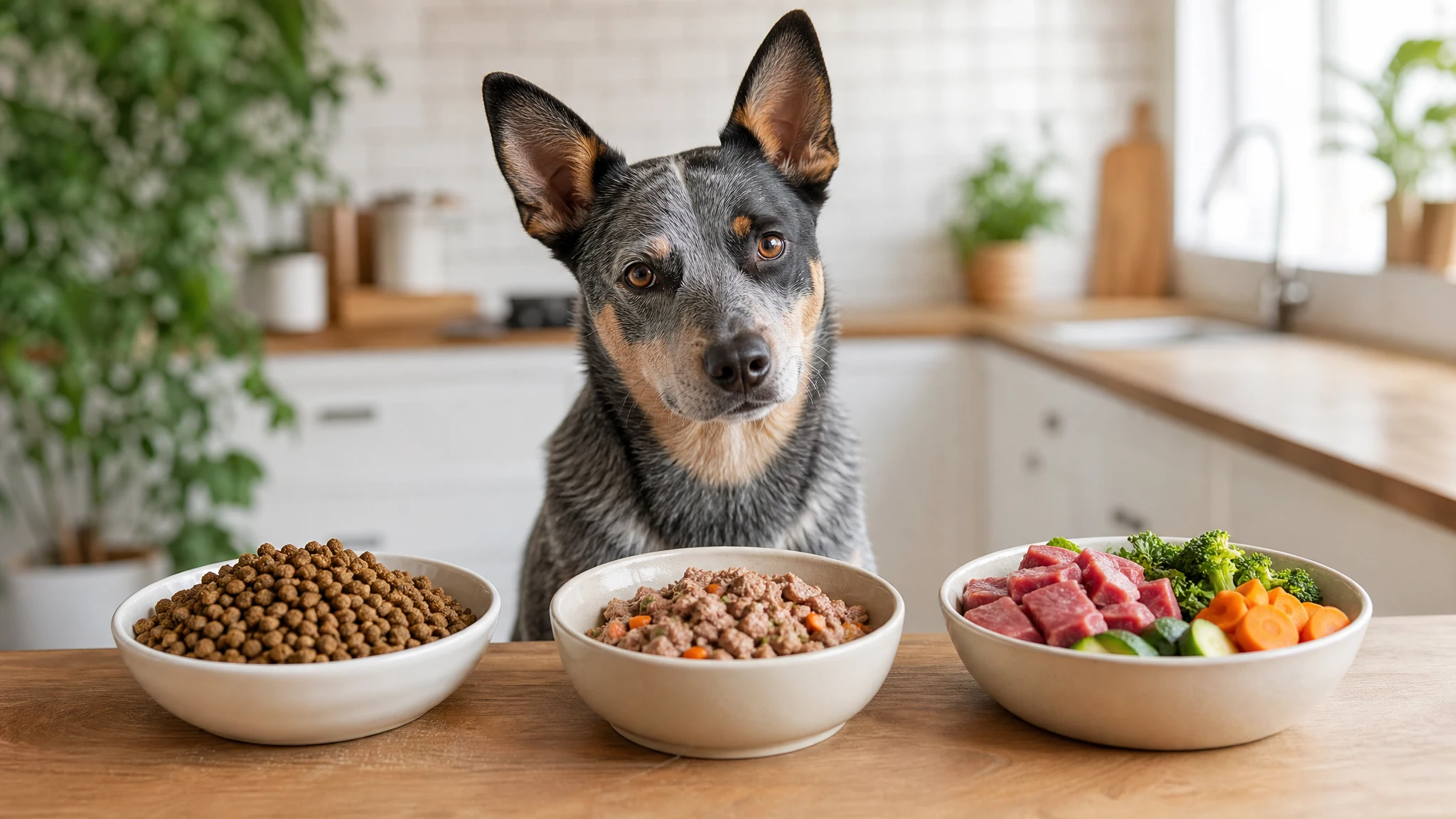
General nutrition information compiled from product labels and published sources, not veterinary advice. Your veterinarian is the right person to choose a diet for your dog, especially one with a health condition.
Blue Heeler owners often ask whether kibble, canned food or a refrigerated roll is the better fit. The honest answer is that all three can be complete and balanced. They differ in water content, calorie density, handling and cost, and those differences matter more than the marketing.
This page compares the three forms using label data from nine real products. We compared labels. We did not run feeding trials or taste tests, and we have not fed any of these foods to dogs ourselves.
First, what a Blue Heeler needs from any form
"Blue Heeler" is the common name for the Australian Cattle Dog. The Australian Cattle Dog Club of America gives heights of 18 to 20 inches for males and 17 to 19 inches for females. PetMD and MetLife Pet Insurance both list an adult weight of 35 to 50 pounds. That is a medium dog, well under the 70 pound line AAFCO uses for large-breed puppy foods.
PetMD describes the Heeler as an active breed. It says calorically dense, high-quality diets may be ideal, that two feedings a day is typical, and that amounts should follow the bag guidance and the dog's ideal weight. PetMD also warns that too many treats lead to overweight Heelers.
So the useful questions are: is the food complete and balanced for my dog's life stage, how many calories are in a serving, and can I measure it accurately twice a day?
How the three forms differ on the label
Moisture changes how you read every number. A canned food whose first ingredient is water will show a low protein percentage on the label, even if its protein is high once the water is removed. That is why the Hill's wet foods below are listed with dry matter averages and the dry foods with as-fed minimums. The two sets of numbers cannot be compared directly.
| Attribute | Dry | Wet (canned) | Fresh (refrigerated roll) |
|---|---|---|---|
| Examples compared | Royal Canin Medium Adult, Hill's Science Diet Adult Perfect Digestion, VICTOR Hi-Pro Plus | Hill's Science Diet Adult Savory Stew, Hill's Science Diet Puppy Chicken & Barley Entree | Freshpet Tender Chicken Recipe, Freshpet Grain-Free Chicken Recipe with Spinach & Potato |
| Moisture clue on the label | No water among the first five ingredients in the examples | Water is the first ingredient in both examples | Chicken and chicken broth lead the ingredient lists |
| Calories (as stated by the brand) | 340 to 406 kcal per cup | About 329 kcal per 12.8 oz can (stew); 495 kcal per 13 oz can (puppy) | 316 and 303 kcal per 1/2 lb; no per-cup figure given |
| Measuring unit | Cups, or grams | Cans | Slices or cubes cut from a roll |
| Storage | Check the bag | Check the can | Refrigerated product; follow the package |
| Kibble size | The brand pages do not list a kibble size for any of these products. Ask the brand if size matters for your dog. | ||
| Relative daily cost | Usually the lowest of the three | Usually higher than dry for the same calories | Usually the highest of the three |
The cost row is a general pattern, not a price. Prices change by store, bag size and region, so work out cost per day yourself: divide the package price by the number of days it lasts for your dog.
Dry food
Dry food is the default for good reasons. The calorie density is high, so a 35 to 50 pound Heeler eats a manageable volume. Royal Canin's Medium Adult lists 340 kcal per cup, and the Hill's Adult Perfect Digestion Chicken & Barley lists 368 kcal per cup. Royal Canin also says grams are the most accurate way to measure, and it recommends two to four equal portions a day.
For an active dog, there is a higher-energy option. The VICTOR Hi-Pro Plus label lists 30 percent minimum protein, 20 percent minimum fat and 406 kcal per cup. VICTOR describes it as a high-energy formula for active dogs. Its statement covers all life stages except growth of large-size dogs (70 pounds or more as an adult), which does not exclude a Heeler.
Pros
- High calories per cup, so smaller volumes for an active dog.
- Easy to measure, especially by weight on a kitchen scale.
- Simple to store and portion into two meals.
- Generally the lowest cost per day of the three forms.
Cons
- Low in water, so the dog gets less moisture from the food itself.
- Easy to overfeed by scooping, since a heaping cup can hold noticeably more than a level one.
- Kibble size is not stated on the pages we compared.
Wet food
People searching for wet food for Blue Heelers often want a softer, stronger-smelling option for a picky eater, or something easier to chew for an older dog. The Hill's examples show the trade-offs clearly.
The Adult Savory Stew with Chicken & Vegetables lists water, pork liver, chicken, carrots and pork kidney as its first five ingredients. It has about 329 kcal in a 12.8 oz can. Hill's gives dry matter averages of 27.8 percent protein and 19.1 percent fat, not guaranteed minimums.
Compare the calories. A cup of Royal Canin Medium Adult has about 340 kcal, and one can of the stew has about 329. Roughly speaking, a dog needing the calories of two cups of dry food would need around two cans a day if fed wet alone. That adds up in cost and in storage of opened cans.
Pros
- Much higher water content, shown by water leading the ingredient list.
- Soft texture and strong aroma, which can help with a reluctant eater.
- Works well as a topper in small amounts.
Cons
- Fewer calories per ounce, so more cans for an energetic Heeler.
- Usually costs more per day than dry for the same calories.
- Opened cans need to be handled and stored carefully.
Fresh food
Fresh dog food for Blue Heelers usually means a refrigerated roll that you slice. Freshpet's Tender Chicken Recipe with Carrots, Peas & Brown Rice lists chicken, carrots, chicken broth, peas and eggs first. It states 9.5 percent minimum protein, 7 percent minimum fat and 1394 kcal per kilogram (316 kcal per half pound). The brand asks owners to cut the roll into cubes of one inch or smaller using the serving marks on the package.
The Grain-Free Chicken Recipe with Spinach & Potato is similar at 303 kcal per half pound. It is a grain-free recipe. On that topic, the FDA says its investigation into diet and canine dilated cardiomyopathy (DCM) is described as a complex scientific issue that is not resolved. Its latest update is dated December 23, 2022, and it says adverse event reports alone do not establish cause. Whether a grain-free recipe suits your dog is a question for your veterinarian.
The as-fed protein of 9.5 to 10 percent looks small beside a dry food's 23 to 30 percent, but that gap mostly reflects water. It does not tell you one food has less protein in a meaningful sense. To compare, you would need dry matter figures, which the Freshpet page does not give.
Pros
- Whole-food style ingredient lists that many owners find easy to read.
- High moisture, with a soft texture.
- Sliced portions can be sized by weight.
Cons
- Needs refrigeration and careful handling.
- Usually the highest cost per day of the three forms.
- The page gives calories per kilogram and per half pound, not per cup, so it is harder to swap in for a scoop of kibble.
- Calories per pound are well below dry food, so the volume to feed is larger.
Dental myths
A common belief is that dry food cleans a dog's teeth and wet food ruins them. None of the manufacturer pages we compared make a dental claim that we can rely on, and the research we reviewed for this page does not settle the question. We would rather not repeat a claim we cannot source.
What we can say is that a food's form alone should not be your dental plan. Dental care is a conversation to have with your veterinarian, who can look at your dog's mouth.
Mixing forms
Many owners combine forms, such as dry food with a spoonful of wet food on top. That can work, with two cautions.
- Count the calories of both. A topper adds calories on top of the base meal. Reduce the dry portion so the total stays near the amount your dog needs. PetMD links Heelers' weight problems to excess treats, and toppers can act like treats.
- Change gradually. Hill's suggests switching foods by mixing increasing amounts of the new food with decreasing amounts of the old food over 7 days.
Use the feeding guide on each package as a starting point, then adjust to your dog's body condition with your veterinarian's help. Hill's own pages say to adjust amounts as necessary to maintain optimal weight and to ask your veterinarian if unsure.
Puppies
Heeler puppies do not need a large-breed puppy formula, because the adult weight of 35 to 50 pounds is below AAFCO's 70 pound large-breed line. Look for a statement that the food is complete and balanced for growth or for all life stages. Royal Canin's Medium Puppy is formulated for growth including large-size dogs, with 410 kcal per cup. VICTOR's Hi-Pro Plus Small & Medium Breed Puppy carries an all-life-stages statement that excludes growth of large-size dogs. Hill's Puppy Chicken & Barley Entree is a wet option at about 495 kcal per 13 oz can.
Growth rate matters in any growing dog, and free-feeding is discouraged, according to the IVC Journal. PetHealthMD says free-feeding puppies leads to excess weight gain that strains growing bones and joints. VICTOR's own guide for its puppy food suggests four feedings a day. Treat any package guide as a starting point and ask your veterinarian how fast your puppy should grow.
Best for, by use case
| Situation | Form worth considering | Why |
|---|---|---|
| Active adult, cost-conscious | Dry | High calories per cup and usually the lowest cost per day. |
| Picky eater | Dry with a small wet or fresh topper | Aroma and texture, while keeping the base affordable. |
| Older dog with chewing trouble | Wet, or dry moistened as your veterinarian advises | Softer texture. Hill's lists an Adult 7+ dry food for mature adults too. |
| Owner who wants minimally processed-looking ingredients | Fresh | Short whole-food ingredient lists, if the budget and fridge space allow. |
| Growing puppy | Any complete-and-balanced growth food | The AAFCO statement and measured portions matter more than the form. |
The verdict
For most Blue Heelers, a complete and balanced dry food is the practical base. It packs the most calories per cup, it is easy to weigh out for two meals a day, and it usually costs the least. That fits an active breed that PetMD says may do well on calorically dense diets.
Wet and fresh foods are reasonable choices, not lesser ones. Use wet food when texture or appetite is the issue. Choose fresh if the ingredients, storage and cost suit your household. In either case, plan on larger volumes for the same calories, and measure by weight where you can.
No form prevents or treats a health condition. Hip and elbow dysplasia, eye disease and deafness in the breed are inherited issues that the Australian Cattle Dog Club of America addresses through health testing, not through a food format. Your veterinarian decides what is right for an individual dog.
To go deeper on specific products, see our label-by-label comparison of dog foods for Blue Heelers.
Sources
- PetMD, Australian Cattle Dog breed page
- Australian Cattle Dog Club of America, Your New Australian Cattle Dog
- Australian Cattle Dog Club of America, OFA-CHIC Health Testing Requirements
- MetLife Pet Insurance, Australian Cattle Dog breed spotlight
- AAFCO, Understanding Pet Food
- AAFCO, Reading Labels
- FDA CVM, Investigation into Potential Link between Certain Diets and Canine Dilated Cardiomyopathy
- IVC Journal, Feeding large breed puppies
- PetHealthMD, Feeding Your Large Breed Puppy
- Royal Canin US, Medium Adult
- Hill's Pet Nutrition, Science Diet Adult Perfect Digestion
- VICTOR Pet Food, Hi-Pro Plus
- Freshpet, Tender Chicken Recipe with Carrots, Peas & Brown Rice