Australian Cattle Dog Puppy: First-Year Feeding and Care Basics
General nutrition information compiled from product labels and published sources, not veterinary advice. Your veterinarian is the right person to choose a diet for your dog, especially one with a health condition.
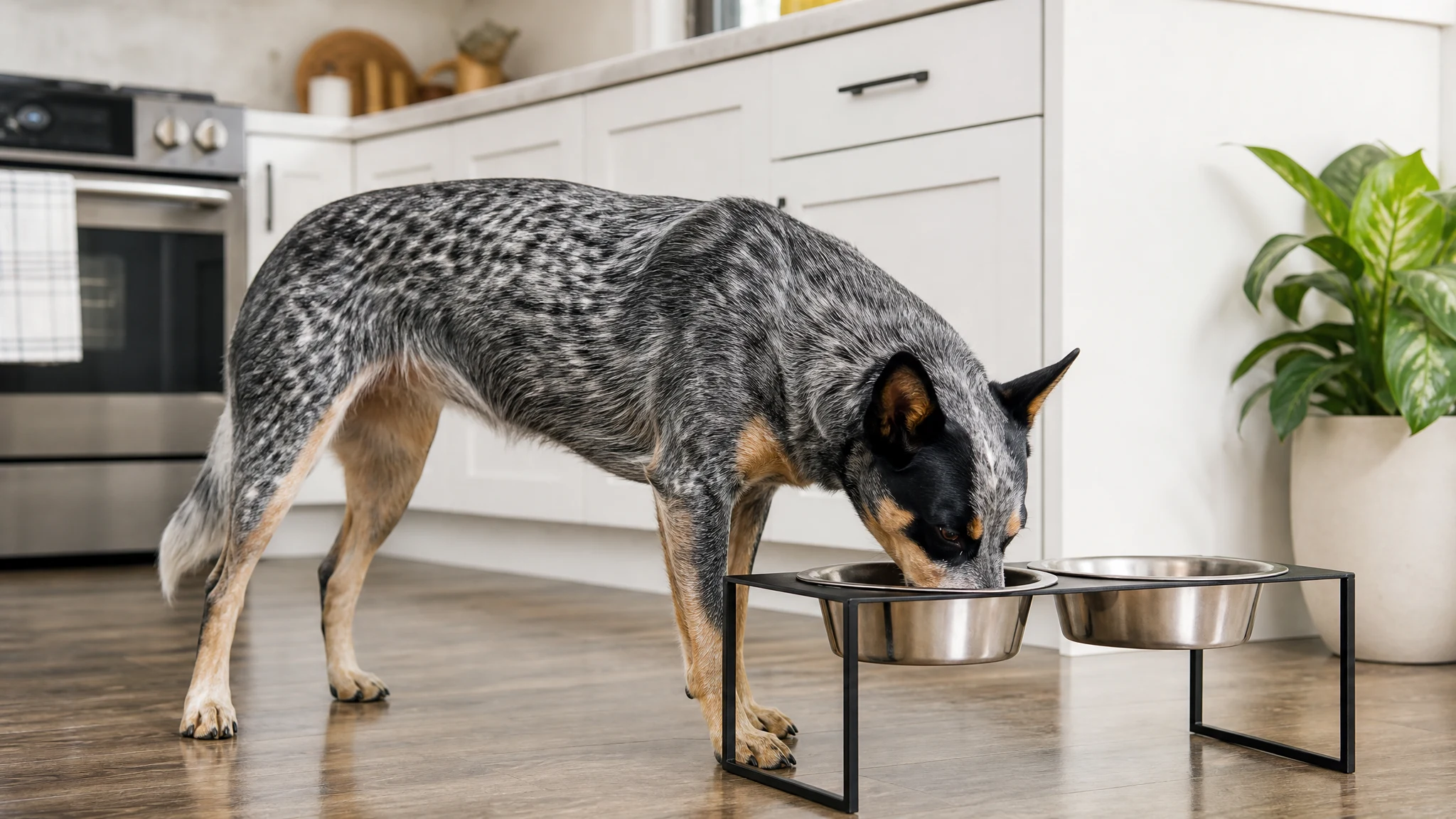
A Blue Heeler puppy is a medium-sized dog with a lot of energy. The official breed name is Australian Cattle Dog, and "Blue Heeler" is the common name most owners use. This guide walks through the first year of feeding in order, from picking a label to adjusting portions as your puppy grows.
We compared label data from brand pages and read breed club and veterinary sources. We did not run feeding trials or taste tests, and nothing here replaces your veterinarian's advice for your own dog.
What You Will Need
- A complete and balanced puppy food, or an all-life-stages food, with an AAFCO nutritional adequacy statement on the label
- A kitchen scale or measuring cup, so portions stay consistent
- A feeding bowl and a fixed feeding spot
- Small, low-calorie treats for training
- A notebook or phone note to log weight, portions and treats
- A veterinarian you can call with questions
Know the Breed Before You Pick a Food
Adult Blue Heelers weigh about 35 to 50 pounds, according to PetMD and MetLife Pet Insurance. The Australian Cattle Dog Club of America lists adult height at 18 to 20 inches for males and 17 to 19 inches for females, and life expectancy at about 12 to 16 years.
That puts the breed in the medium range. AAFCO defines a large-size dog as one expected to reach 70 pounds or more as an adult, so a Heeler does not need a large-breed puppy formula. Check with your veterinarian if your puppy's parents were unusually big.
PetMD describes the breed as active and says calorically dense, high-quality diets may suit it well. It also warns that too many treats can lead to an overweight Heeler.
Step 1: Read the Adequacy Statement First
AAFCO says it sets model language and does not approve or certify pet food. The statement on the bag is the brand's own claim. AAFCO recognizes four life stages: gestation/lactation, growth, maintenance and all life stages.
For a puppy, look for "growth" or "all life stages." A food labeled only for adult maintenance is not meant for a growing dog.
Next, read the fine print. Whole Dog Journal explains that some statements say a food is complete for "growth of large-size dogs (70 pounds or more as an adult)" and others say "except for" that group. A Heeler is not in the large-size class, so either wording can apply. The wording matters mainly for owners of bigger breeds.
Examples from brand pages show the difference. Royal Canin's Medium Puppy states it meets AAFCO levels for growth, including growth of large-size dogs. VICTOR's Hi-Pro Plus Small & Medium Breed Puppy states it meets AAFCO levels for all life stages, except for growth of large-size dogs. Both are described as meeting a standard that fits a medium-sized puppy.
Step 2: Compare Label Data, Not Marketing
Put two or three candidate foods side by side and compare the same facts for each. Here are a few puppy examples taken from the brands' own pages:
| Food | Form | Protein (min) | Fat (min) | Calories |
|---|---|---|---|---|
| Royal Canin Size Health Nutrition Medium Puppy | Dry | 30.0% | 18.4% | 410 kcal ME per cup |
| VICTOR Hi-Pro Plus Small & Medium Breed Puppy | Dry | 30.0% | 18.0% | 383 kcal per cup |
| Hill's Science Diet Puppy Chicken & Barley Entree | Wet (13 oz can) | Dry matter average 29% | Dry matter average 20.3% | 495 kcal per can |
Hill's lists dry matter averages rather than guaranteed minimums, so do not compare that row directly to the other two. Wet food is also measured per can, not per cup. None of these pages gives a kibble size, so check the brand if your puppy struggles with the pieces.
The first ingredients differ too. Royal Canin Medium Puppy starts with chicken by-product meal, chicken fat and brewers rice. VICTOR's puppy formula starts with beef, chicken, beef meal and chicken meal. Ingredient order tells you what the recipe leads with. It does not tell you how well a food will work for your dog.
For a wider look, see our label-by-label comparison of dog foods for Blue Heelers. It covers adult and senior options as well.
Step 3: Set a Starting Portion From the Label
Use the feeding guide on the bag as a starting point. PetMD says Heeler portions should follow the bag guidance and the dog's ideal weight. Brand guides are only guides, and Royal Canin says as much on its page.
- Weigh your puppy and note the age.
- Find the matching row in the brand's feeding chart. Royal Canin's puppy page asks for your pet's details to calculate a tailored recommendation.
- Weigh or measure the daily total, then divide it into meals.
- Write down the amount so everyone in the house feeds the same portion.
If your puppy has a health condition, confirm the amount with your veterinarian before you rely on a bag chart.
Step 4: Choose a Schedule and Stick to It
PetMD says Heelers are typically fed twice a day. Puppy labels often suggest more meals. VICTOR's puppy page, for example, describes four feeding intervals spaced through the day, while Royal Canin's adult page suggests two to four equal portions. Ask your veterinarian how many meals suit your puppy's age.
Pick set times and pick up the bowl when the meal is over. Do not free-feed. IVC Journal and PetHealthMD both note that rate of growth and calories matter for developing bones and joints, and that free-feeding can lead to excess weight gain that strains them.
Step 5: Watch Growth and Adjust
Check your puppy's weight on a regular schedule and look at body shape. You should be able to feel the ribs under a light covering. If your puppy gains too fast or looks thin, ask your veterinarian before changing the amount. Then update your notes.
Joint health is one reason to care about steady growth. The Australian Cattle Dog Club of America lists hip and elbow evaluation among its health testing requirements, and PetMD calls hip dysplasia uncommon in the breed. Diet cannot prevent or treat these conditions. A lean puppy on a measured diet is simply easier on growing joints, and your veterinarian decides what is right for an individual dog.
Step 6: Use Treats the Right Way
Heelers are quick learners, which makes food rewards handy. Reward-based training is the approach recommended by the American Veterinary Society of Animal Behavior.
- Use tiny pieces so a training session adds few calories.
- Count treats toward the day's total and trim the meal if you give a lot.
- Use part of the daily kibble as training rewards when you can.
Step 7: Switch Foods Slowly
You will change foods at least once, when your puppy moves to an adult diet. Hill's suggests mixing increasing amounts of the new food with decreasing amounts of the old over 7 days. Many owners find that a gradual change is easier on the stomach.
No source we reviewed gives a set age at which a Blue Heeler counts as an adult. Ask your veterinarian or breeder when to move to an adult or all-life-stages food.
Basic Care Alongside Feeding
- Exercise: This is an active breed. Pair daily activity with measured meals so calories stay in balance.
- Vet visits: Ask about vaccines, parasite prevention and a growth plan at the first visit.
- Health screening: Inherited conditions in this breed include progressive retinal atrophy, primary lens luxation and congenital deafness. These are not managed by diet. The Australian Cattle Dog Club of America's CHIC page lists the tests breeders are expected to do. Ask your breeder for results.
- Supplements: Do not add any without asking your veterinarian. Never guess at amounts.
Common Mistakes to Avoid
- Feeding an adult-maintenance food to a puppy. Check that the statement covers growth or all life stages.
- Buying a large-breed puppy formula by default. A 35 to 50 pound dog is below the 70 pound large-size cutoff.
- Free-feeding. It makes portions impossible to track.
- Counting only meals. Treats and chews add up quickly.
- Chasing grain-free labels. The FDA's investigation into diet and canine dilated cardiomyopathy (DCM) was last updated on December 23, 2022. The FDA calls the link a complex scientific issue that is not resolved, and says adverse event reports alone do not establish cause. If you have questions about DCM and your puppy's food, ask your veterinarian.
- Switching foods overnight.
What to Expect
With a suitable food, measured portions and steady routines, many owners see a puppy with good energy, a trim shape and regular stools. Results vary from dog to dog. Growth rate, genetics, activity and health all play a part, and no food can promise a particular outcome.
Call your veterinarian if your puppy refuses meals, has ongoing digestive upset, loses weight or gains weight quickly. Your vet is also the right person to decide whether any prescription diet is needed.
Sources
- PetMD, Australian Cattle Dog breed page
- MetLife Pet Insurance, Australian Cattle Dog breed spotlight
- Australian Cattle Dog Club of America, Your New Australian Cattle Dog
- Australian Cattle Dog Club of America, OFA-CHIC Health Testing Requirements
- AAFCO, Understanding Pet Food
- AAFCO, Reading Labels
- Whole Dog Journal, In the Fine Print: Nutritional Adequacy Statements
- IVC Journal, Feeding large breed puppies
- PetHealthMD, Feeding Your Large Breed Puppy
- FDA CVM, Investigation into Potential Link between Certain Diets and Canine Dilated Cardiomyopathy
- Royal Canin, Size Health Nutrition Medium Puppy
- VICTOR, Hi-Pro Plus Small & Medium Breed Puppy
- Hill's Science Diet, Puppy Chicken & Barley Entree