Blue Heelers as Family Dogs: What New Owners Should Know About Feeding
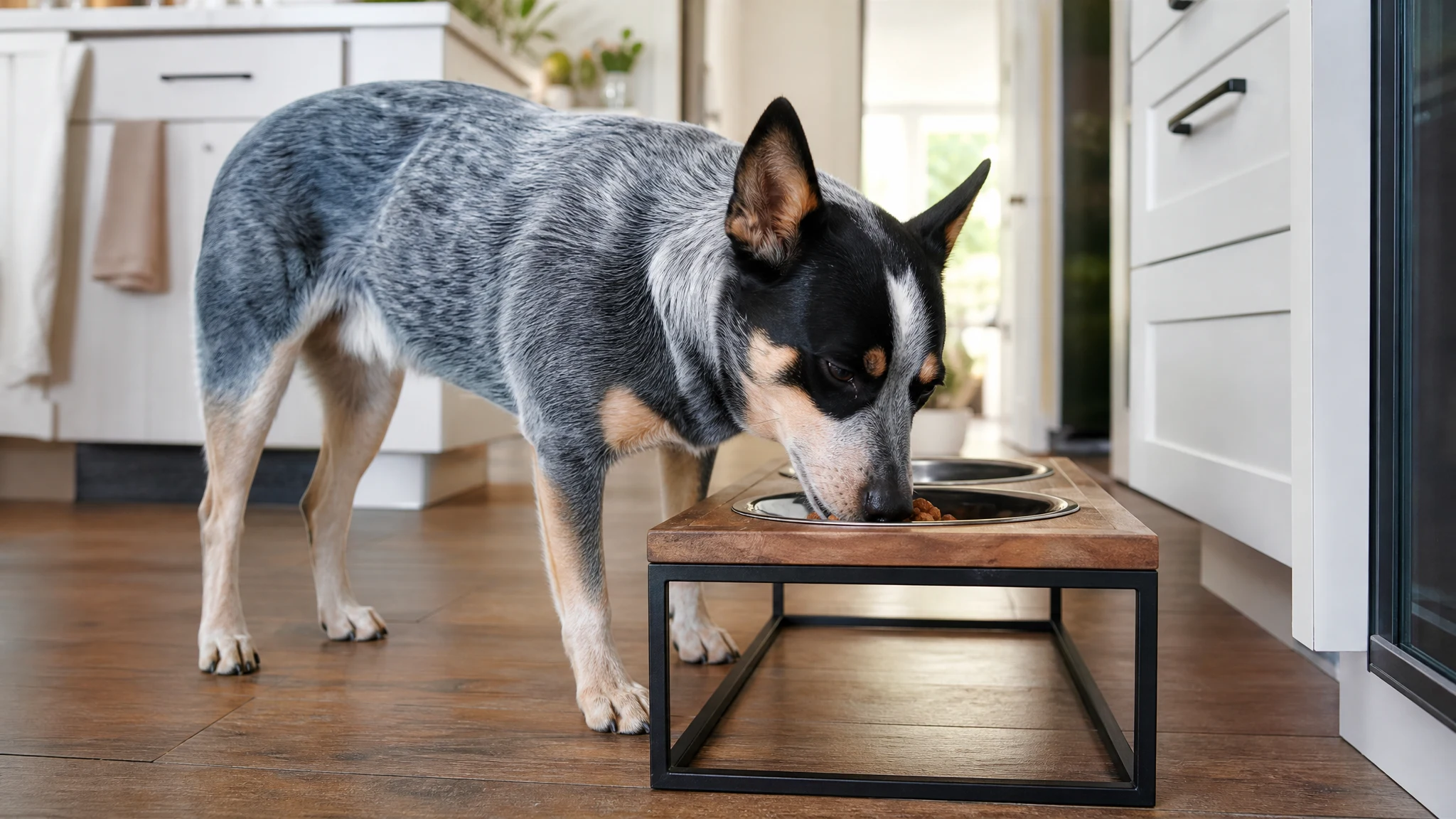
General nutrition information compiled from product labels and published sources, not veterinary advice. Your veterinarian is the right person to choose a diet for your dog, especially one with a health condition.
A Blue Heeler is usually sold as a tireless, smart herding dog. At the dinner bowl, the questions are more ordinary. What do you buy, how much do you scoop, and how often?
This guide walks through those choices in order. It leans on label data and breed information from named sources, and it points out where you should check with your veterinarian or the food's maker.
What to know about the breed first
Blue Heeler is the common name for the Australian Cattle Dog. The Australian Cattle Dog Club of America lists adult height at 18 to 20 inches for males and 17 to 19 inches for females. It gives a life expectancy of about 12 to 16 years. MetLife Pet Insurance and PetMD both give an adult weight of 35 to 50 pounds.
That puts the breed in the medium range. AAFCO's large-breed cutoff is 70 pounds as an adult. So a Blue Heeler puppy does not need a large-breed puppy formula, according to the sources behind this guide.
PetMD describes the breed as active. It says calorically dense, high-quality diets may suit these dogs, that two meals a day is typical, and that amounts should follow the bag guidance and your dog's ideal weight. It also warns that too many treats can make a Heeler overweight.
For a wider look at what shapes a Heeler's diet, see our guide to Blue Heeler nutrition and the diet factors that matter.
Materials you will need
- A complete and balanced dog food that matches your dog's life stage
- A measuring cup, or better, a kitchen scale (Royal Canin's page notes that grams are the most accurate way to measure)
- Two sturdy bowls, one for food and one for water
- A small container for daily treats, so you can count them
- A notebook or phone note to log meals, treats and body condition
- Your veterinarian's contact details for questions about weight or health
Step 1: Match the food to your dog's life stage
AAFCO's Reading Labels page lists four recognized life stages: gestation and lactation, growth, maintenance, and all life stages. Find the adequacy statement on the bag. It is usually a small paragraph near the ingredient list.
For a puppy, look for growth or all life stages. For an adult, maintenance or all life stages works. AAFCO says it sets model language and does not approve or certify pet food. The statement is the maker's claim, not an AAFCO endorsement.
One wording detail matters for Heelers. Some statements say "including growth of large size dogs (70 pounds or more as an adult)." Others say "except for" that group, according to Whole Dog Journal. Because a Heeler is under 70 pounds, either version can fit a puppy of this breed. The large-size clause simply does not apply.
The facts available to us do not say exactly when a Heeler counts as an adult. Ask your veterinarian or breeder when to switch, and check the brand's own guidance.
Step 2: Compare labels, not marketing
We compared label data published on brand pages. We did not run feeding trials or taste tests, and this is not a ranking. Use these examples to see what to look for. They are not endorsements.
| Food | Stage | Label details |
|---|---|---|
| Royal Canin Size Health Nutrition Medium Adult | Adult maintenance | 340 kcal ME per cup; minimum protein 23%, fat 12%; first ingredient brewers rice |
| Royal Canin Size Health Nutrition Medium Puppy | Growth | 410 kcal ME per cup; minimum protein 30%, fat 18.4% |
| Hill's Science Diet Adult Perfect Digestion Chicken & Barley | Adult maintenance | 368 kcal per cup; first ingredient chicken; the page lists dry matter averages, not guaranteed minimums |
| VICTOR Hi-Pro Plus | All life stages except large-size growth | 406 kcal per cup; minimum protein 30%, fat 20%; aimed at high-energy dogs |
| VICTOR Hi-Pro Plus Small & Medium Breed Puppy | Puppy | 383 kcal per cup; minimum protein 30%, fat 18% |
| Freshpet Tender Chicken Recipe | Adult maintenance | Fresh roll; 1394 kcal/kg; minimum protein 9.5%, fat 7% (moisture is much higher than in kibble) |
Kibble size is not stated on these pages, so check the bag if you have a small puppy. None of these is made specifically for Blue Heelers. Percentages in a fresh or wet food are not directly comparable to dry kibble, because of the water content.
Step 3: Set a meal schedule
PetMD says two feedings per day is typical for the breed. Many new owners start there for adults and split the day into morning and evening.
Puppies often need more meals. VICTOR's puppy page suggests four feeding intervals spaced through the day. Your veterinarian can tell you when to step down to fewer meals.
Avoid free-feeding a puppy. The IVC Journal and PetHealthMD both say rate of growth and calories matter for growing bones and joints, and PetHealthMD says free-feeding leads to excess weight gain that strains them. Set meals and take the bowl up when time is up.
Step 4: Start from the label's feeding guide
Every feeding chart is a starting point. Royal Canin's page says its guide is "only a guide." Hill's says to adjust amounts as needed to maintain optimal weight and to ask your veterinarian if unsure.
- Read the chart on your food for your dog's current weight.
- Weigh the portion on a scale if you can.
- Split the day's amount across your meals.
- Subtract a little if you will use many training treats that day.
- Check your dog's body shape every week or two and adjust.
Heelers are lean, muscular dogs. You should be able to feel the ribs under a light covering, and see a waist from above. If you cannot tell, ask your veterinarian to show you what a healthy shape looks like on your dog.
Watch the calories on the label as well. Foods in the table above range from 340 to 410 kcal per cup, so a cup of one is not the same as a cup of another. Never swap foods cup for cup without checking the new chart.
Step 5: Switch foods slowly
Hill's suggests mixing increasing amounts of the new food with decreasing amounts of the old over 7 days. Follow that pattern whenever you change foods, including the move from puppy to adult. If stools stay loose or your dog stops eating, call your veterinarian.
Step 6: Plan treats and add-ins
This breed is smart and food-motivated, which makes reward-based training easy. It also makes extra calories easy. Use part of the daily meal as training rewards when you can, and count the rest.
Do not add supplements on your own. Joint products come up often with this breed. PetMD notes that joint supplements or NSAIDs are used to manage hip dysplasia symptoms, but any product, amount or schedule should come from your veterinarian.
Tips for success
- Keep fresh water out at all times.
- Feed in a calm spot and give your dog a rest after meals.
- Keep a simple log so you notice weight changes early.
- Ask the breeder or rescue what the puppy has been eating, and keep it the same at first.
- Confirm amounts with your veterinarian if your dog has any health condition, is very active, or is losing or gaining weight.
Common mistakes to avoid
- Buying a large-breed puppy food by default. A 35 to 50 pound adult is below the 70 pound line.
- Trusting the front of the bag. Read the adequacy statement, ingredient list and calories.
- Free-feeding a puppy. Measured meals make it easier to control growth.
- Treating the chart as a rule. Adjust to body shape, with your veterinarian's input.
- Uncounted treats. PetMD names this as a path to an overweight Heeler.
- Chasing diet trends. The FDA's investigation into diet and canine dilated cardiomyopathy (DCM) has not resolved the question. Its latest update is dated December 23, 2022, and it says adverse event reports alone do not establish cause. If you have concerns, talk to your veterinarian.
- Expecting food to handle inherited problems. Eye conditions such as progressive retinal atrophy and primary lens luxation, and congenital deafness, are not diet related, according to the sources above.
What results to expect
With a suitable food, steady portions and counted treats, many owners see a dog that holds a lean shape, has regular stools and keeps up its energy on walks and in play. A good plan may also help support healthy growth in a puppy. Results vary, and no food can promise to prevent or treat a disease. Joint conditions such as hip and elbow dysplasia, which the Australian Cattle Dog Club of America lists in its health testing requirements, are matters for your veterinarian.
Check in with your veterinarian at routine visits and any time your dog's weight, appetite or stools change.
Sources
- PetMD, Australian Cattle Dog breed page
- Australian Cattle Dog Club of America, Your New Australian Cattle Dog
- Australian Cattle Dog Club of America, OFA-CHIC Health Testing Requirements
- MetLife Pet Insurance, Australian Cattle Dog breed spotlight
- AAFCO, Understanding Pet Food
- AAFCO, Reading Labels
- Whole Dog Journal, In the Fine Print: Nutritional Adequacy Statements
- IVC Journal, Feeding large breed puppies
- PetHealthMD, Feeding Your Large Breed Puppy
- FDA CVM, Investigation into Potential Link between Certain Diets and Canine Dilated Cardiomyopathy
- Brand product pages: Royal Canin, Hill's Pet Nutrition, VICTOR Pet Food and Freshpet (linked in the table above)