How Much to Feed a Blue Heeler: Feeding Chart by Age and Weight
General nutrition information compiled from product labels and published sources, not veterinary advice. Your veterinarian is the right person to choose a diet for your dog, especially one with a health condition.
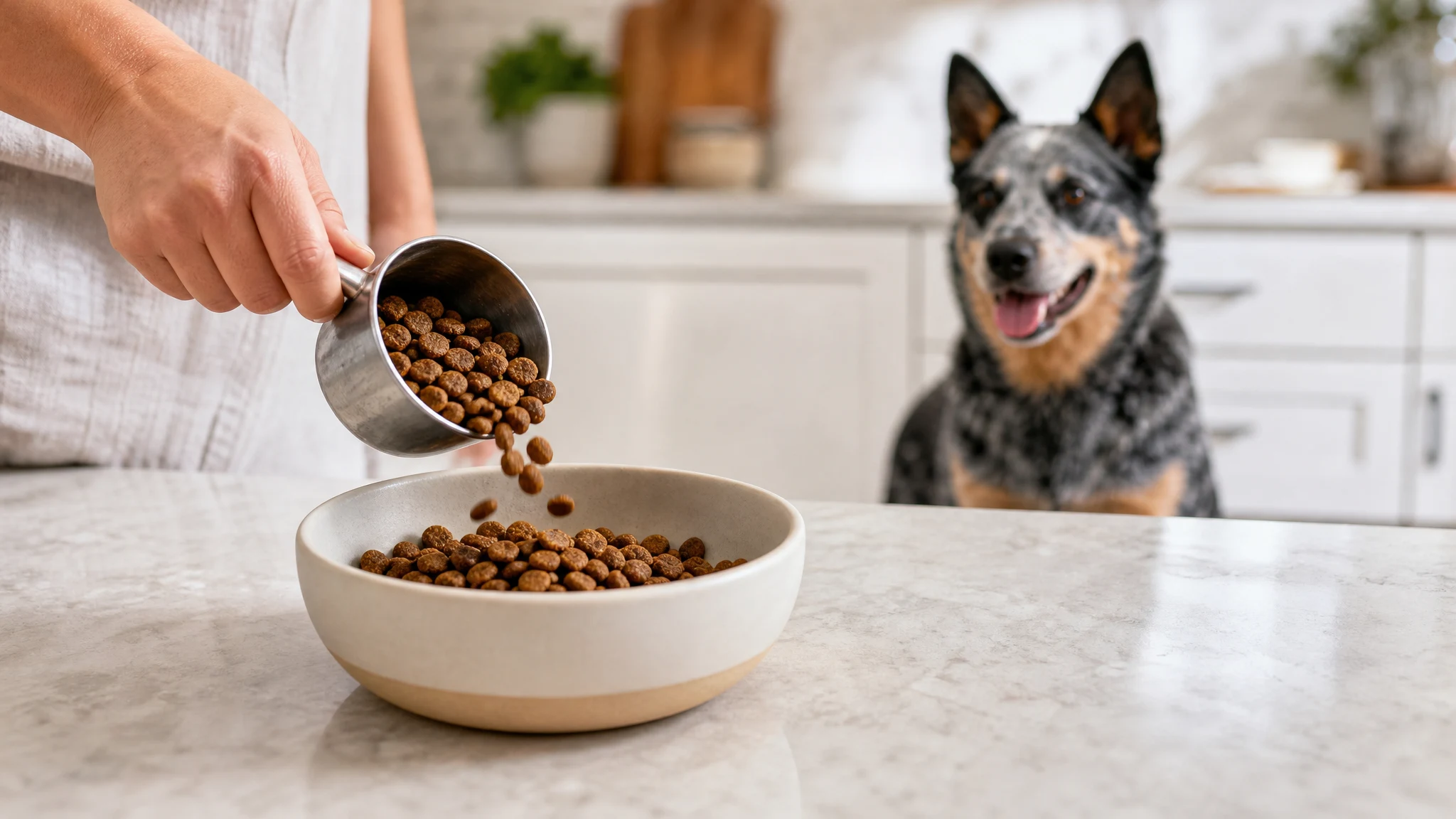
Most owners ask the same thing sooner or later: how much should a Blue Heeler eat each day? The honest answer is that no single number fits every dog. A lean, busy working Heeler and a couch-friendly one of the same weight can need very different amounts.
This guide shows you how to find a sensible starting amount from the food label, set it against your dog's age and weight, and adjust it by watching your dog's body. It is a label-reading method, not a prescription.
One note on method: we compared label data from the brands' own pages. We did not run feeding trials or taste tests, and we have not fed these foods to dogs ourselves.
What You Need Before You Start
- The bag, can or package of the food you are feeding, with its feeding guide and calorie statement.
- A standard dry measuring cup, or better, a kitchen scale. Royal Canin's page says grams are the most accurate form of measurement.
- A scale to weigh your dog. A bathroom scale works: weigh yourself, then yourself holding the dog, and subtract.
- A notebook or phone note to log weight, portions and treats.
- Your veterinarian's contact details, because the vet sets the final amount for your individual dog.
Know the Size You Are Feeding For
The Australian Cattle Dog, the breed most people call the Blue Heeler, is a medium dog. MetLife Pet Insurance and PetMD both give an adult weight of 35 to 50 lb. The Australian Cattle Dog Club of America lists height at 18 to 20 inches for males and 17 to 19 inches for females at the withers.
That weight range matters for food choice. AAFCO's large-size cutoff is 70 lb or more as an adult, and Blue Heelers fall well below it. According to IVC Journal, that means large-breed puppy formulas are not required for this breed.
PetMD describes Heelers as an active breed and says calorically dense, high-quality diets may be ideal. It also says two feedings per day is typical, and that amounts should follow the bag guidance and the dog's ideal weight.
Step 1: Pick a Complete and Balanced Food for Your Dog's Life Stage
Start with the nutritional adequacy statement, usually in small print near the ingredients. AAFCO's Reading Labels page lists the recognized life stages: gestation/lactation, growth, maintenance and all life stages.
AAFCO sets model language but does not approve or certify pet food, so the statement tells you what the maker says the food is formulated or tested to meet.
- A puppy needs a growth or all-life-stages statement.
- An adult needs maintenance or all life stages.
- Watch the large-size clause. Whole Dog Journal explains that foods with the "except for growth of large size dogs" wording should not be fed to large-breed puppies. Since a Heeler is not a large-size dog, that wording is not a problem for this breed.
For a side-by-side look at specific foods, see our label-by-label comparison of dog foods for Blue Heelers.
Step 2: Find the Calories in Your Food
Cups are not equal across foods. A cup of one food can hold noticeably more energy than a cup of another. The table below shows the label data we have for several foods, so you can see how much that varies.
| Food (brand page) | Form and life stage | Energy on the label | What the label says about feeding |
|---|---|---|---|
| Royal Canin Size Health Nutrition Medium Puppy | Dry, growth | 410 kcal ME per cup (as fed, calculated) | The page asks for your pet's details to calculate a tailored recommendation. |
| VICTOR Hi-Pro Plus Small & Medium Breed Puppy | Dry, puppy | 383 kcal per cup | Feed as much as the puppy will eat in 20 minutes, in 4 feeding intervals spaced through the day. |
| Hill's Science Diet Puppy Chicken & Barley Entree | Wet, puppy (13 oz can) | 495 kcal per can | Adjust amounts as necessary to maintain optimal weight. |
| Royal Canin Size Health Nutrition Medium Adult | Dry, adult maintenance | 340 kcal ME per cup (as fed, calculated) | Only a guide. The page recommends 2 to 4 equal portions per day. |
| Hill's Science Diet Adult Perfect Digestion Chicken & Barley | Dry, adult 1 to 6 | 368 kcal per cup | Adjust amounts as necessary to maintain optimal weight. If unsure, ask your veterinarian. |
| VICTOR Hi-Pro Plus | Dry, all life stages except large-size growth | 406 kcal per cup | The page gives an increase of 1/2 cup for every 20 lb over 100 lb, which does not apply to a Heeler's size. |
| Hill's Science Diet Adult 7+ Chicken Meal, Barley & Rice | Dry, mature adult 7+ | 352 kcal per cup | When switching foods, mix the new food in gradually over 7 days. |
| Hill's Science Diet Adult Savory Stew with Chicken & Vegetables | Wet, adult (12.8 oz can) | About 329 kcal per can | Adjust amounts as necessary to maintain optimal weight. |
| Freshpet Tender Chicken Recipe with Carrots, Peas & Brown Rice | Fresh roll, adult | 316 kcal per 1/2 lb (calculated); no per-cup figure | Use the serving size marks on the package, then cut into 1-inch cubes or smaller. |
Notice that the wet and fresh foods are measured per can or per half pound, not per cup. Do not swap cups for cans or cups for slices without doing the math from the label.
These are label figures from Royal Canin, VICTOR, Hill's Pet Nutrition and Freshpet. We have not tested them. Kibble size is not stated on these pages, so check with the brand if your Heeler has trouble with kibble.
Step 3: Use the Feeding Chart on Your Own Bag
Each brand's chart is built on weight, and some also use age. For a Blue Heeler, this is how to use it:
- Find your dog's current weight in the chart. Do not use the adult weight for a growing puppy.
- Read the daily amount in cups, grams or cans. That is the total for the day, not per meal.
- Divide that total by the number of meals you plan to give.
- Write the number down as your starting amount.
We are not printing a universal cups-per-day chart here, because the amount depends on the specific food's calories, and we have no label figures for a per-weight amount for these products. The charts printed on the packages, or the calculators on the brand pages, are the correct source.
Step 4: Match Meals to Age
Age changes how often to feed more than anything. Here is what the labels in our data suggest.
| Stage | Meal pattern from the sources | What to check |
|---|---|---|
| Growing puppy | VICTOR's puppy page describes 4 feeding intervals through the day. Royal Canin's adult page suggests 2 to 4 equal portions for adults, so check the puppy page for yours. | Use the weight-based chart for the puppy's current weight and a food with a growth or all-life-stages statement. |
| Adult | PetMD says 2 feedings per day is typical for the breed. | Hill's labels its adult food for ages 1 to 6. Our sources do not say exactly when a Heeler counts as an adult, so ask your veterinarian. |
| Mature adult | The same two-meal pattern generally still applies. | Hill's offers an Adult 7+ recipe at 352 kcal per cup. Your vet can say when a change makes sense. |
The Australian Cattle Dog Club of America gives a life expectancy of about 12 to 16 years, so a Heeler may spend a long time in the adult and mature stages. Weight checks matter across all of them.
Puppies: avoid free-feeding
IVC Journal notes that growth rate and calorie intake matter for developmental orthopedic disease in any growing dog, and that free-feeding is discouraged. PetHealthMD adds that free-feeding puppies can lead to excess weight gain that strains growing bones and joints.
The Australian Cattle Dog Club of America's OFA-CHIC requirements include hip and elbow evaluation, so joints are a recognized concern. PetMD calls hip dysplasia uncommon in the breed. Measured meals and a lean puppy are simple habits, but they do not guarantee any health outcome. Your veterinarian can advise on your puppy's growth.
Step 5: Learn Body Condition Scoring
The scale tells you weight. Your hands and eyes tell you condition. Check these once a week:
- Ribs: Run your palms along the sides. You should feel the ribs under a thin layer of padding without pressing hard. If you must dig for them, your dog may be carrying extra weight. If they stand out sharply, ask your vet whether your dog is too thin.
- Waist: Look down from above. A visible narrowing behind the ribs is a good sign.
- Tummy tuck: From the side, the belly should rise up behind the ribcage rather than hang level or sag.
Veterinarians use a numbered scale for this, and your vet can show you where your Heeler lands on it. Ask at the next checkup and take photos to compare over time.
Step 6: Adjust for Activity
A Heeler who herds, runs agility or hikes all weekend burns more than one who gets a daily walk. PetMD's note that this is an active breed with calorically dense diets possibly ideal reflects that.
- Feed the label's starting amount for two weeks.
- Weigh your dog weekly and do the rib and waist check.
- If your dog is slowly gaining and the ribs are getting harder to feel, trim the daily amount slightly.
- If your dog is losing weight without a plan, or looks too lean, talk to your vet before adding food.
- Change one thing at a time, and wait another couple of weeks before judging the result.
Seasonal changes in activity count too. A slow winter may call for a smaller portion than a busy summer.
Step 7: Count the Treats
PetMD warns that excess treats lead to overweight Heelers. Training is a good use of treats, since reward-based methods fit this smart, motivated breed. But the calories add up.
- Use part of the daily kibble as training rewards.
- Keep treats small and count them in the day's total.
- Log extras like chews, table scraps and food-dispensing toys.
Common Mistakes to Avoid
- Using the adult-weight row for a puppy. Use the current weight.
- Scooping with a coffee mug. Use a real measuring cup or a scale.
- Mixing up per-can and per-cup figures. Wet and fresh foods are listed differently.
- Changing foods suddenly. Hill's suggests mixing the new food in over 7 days.
- Ignoring treats. They count toward the day's food.
- Choosing a food for a dog's health condition on your own. Inherited problems such as progressive retinal atrophy, congenital deafness and primary lens luxation are not diet-managed, according to the breed sources. Prescription diets are only something a veterinarian prescribes.
- Chasing grain-free or other trends. The FDA's most recent update on its investigation into diet and canine dilated cardiomyopathy is dated December 23, 2022. The FDA describes the link as a complex scientific issue that is not resolved, and says adverse event reports alone do not establish cause. If this worries you, ask your vet about your dog's food.
What to Expect
If the amount is about right, you may notice steady energy, a stable weight and a visible waist within several weeks. A consistent routine of measured meals may also make your Heeler's weight easier to track.
Results vary by dog, and no feeding plan produces a guaranteed outcome. Food does not prevent or treat hip dysplasia, allergies or any other disease. If your dog's weight, appetite, stool or energy changes, call your veterinarian rather than adjusting the food over and over on your own.
Final Reminder
Label guides are starting points. A veterinarian sets the amount for an individual dog, based on age, weight, body condition, activity and health history. Bring your food label, treat list and weight log to your next visit and ask for a number you can trust.
Sources
- PetMD, Australian Cattle Dog breed page
- MetLife Pet Insurance, Australian Cattle Dog breed spotlight
- Australian Cattle Dog Club of America, Your New Australian Cattle Dog
- Australian Cattle Dog Club of America, OFA-CHIC Health Testing Requirements
- AAFCO, Understanding Pet Food
- AAFCO, Reading Labels
- Whole Dog Journal, In the Fine Print: Nutritional Adequacy Statements
- IVC Journal, Feeding large breed puppies
- PetHealthMD, Feeding Your Large Breed Puppy
- FDA CVM, Investigation into Potential Link between Certain Diets and Canine Dilated Cardiomyopathy
- Royal Canin, Medium Adult (dry)
- Royal Canin, Medium Puppy (dry)
- Hill's Science Diet, Adult Perfect Digestion Chicken & Barley
- Hill's Science Diet, Adult 7+ Chicken Meal, Barley & Rice
- Hill's Science Diet, Adult Savory Stew with Chicken & Vegetables
- Hill's Science Diet, Puppy Chicken & Barley Entree
- VICTOR, Hi-Pro Plus
- VICTOR, Hi-Pro Plus Small & Medium Breed Puppy
- Freshpet, Tender Chicken Recipe with Carrots, Peas & Brown Rice