Living With a Blue Heeler: What Daily Care and Feeding Look Like
General nutrition information compiled from product labels and published sources, not veterinary advice. Your veterinarian is the right person to choose a diet for your dog, especially one with a health condition.
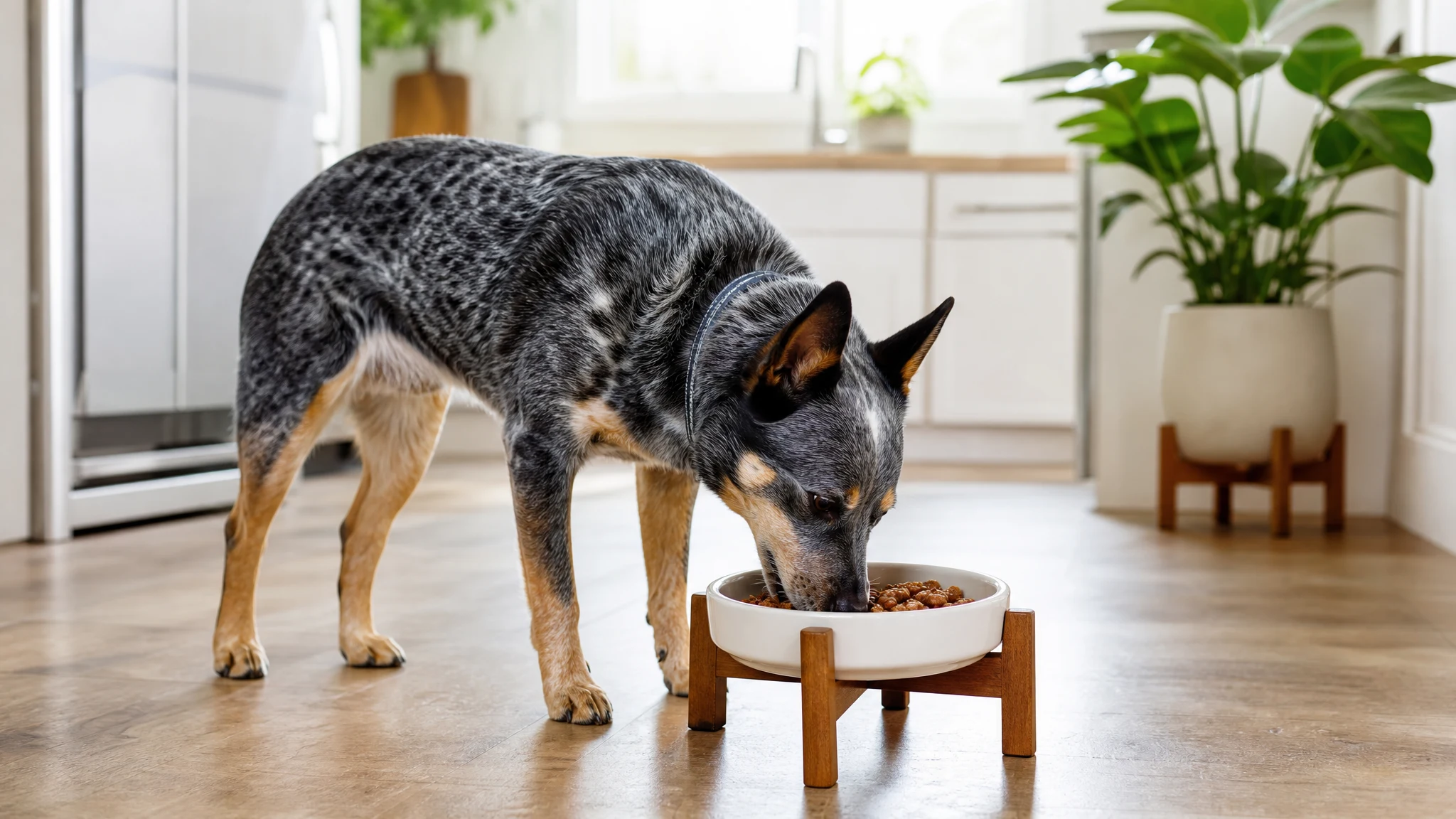
Blue Heelers, officially called Australian Cattle Dogs, are active working dogs. Most of daily life with one comes down to a steady routine: measured meals, sensible treats, exercise, and a regular check on body condition.
This guide walks through that routine in order. It uses published breed information and food label data, and it points out where you should ask your veterinarian or the food maker instead of guessing.
What You Need
- A complete and balanced dog food with an AAFCO nutritional adequacy statement for your dog's life stage.
- A kitchen scale or a dry measuring cup. Royal Canin's own page notes that grams are the most accurate way to measure.
- A bowl for each meal, plus a slow feeder or puzzle bowl if your dog eats fast.
- Low-calorie treats, or part of the daily food ration set aside for training.
- A notebook or phone note to log weight, portions and treats.
- Your veterinarian's contact details, for any question about your individual dog.
Know Your Dog's Size and Energy
The Australian Cattle Dog Club of America lists males at 18 to 20 inches and females at 17 to 19 inches at the withers. PetMD and MetLife Pet Insurance both give an adult weight of 35 to 50 pounds. The club gives life expectancy as about 12 to 16 years.
That puts the breed in the medium range. AAFCO's large-size cutoff is 70 pounds as an adult, so a Blue Heeler does not fall into the large-breed class.
PetMD describes the breed as active and says calorically dense, high-quality diets may be ideal. It also says two feedings a day is typical, and that amounts should follow the bag guidance and the dog's ideal weight.
Step 1: Pick a Food Built Around the Label, Not the Front of the Bag
Start with the AAFCO statement. AAFCO says it sets model language and does not approve or certify pet food. It recognizes four life stages: gestation and lactation, growth, maintenance, and all life stages. Match the statement to your dog's stage.
Then read the ingredient list and guaranteed analysis, and check the calories per cup. Calories matter for a Heeler because a food that looks small in the bowl can still be energy dense.
For a side-by-side look at specific foods, see our label-by-label comparison of dog foods for Blue Heelers. We compared label data from each brand. We did not run feeding trials or taste tests.
To show how much labels differ, here are a few figures from the brands' own pages:
| Food | Life stage on label | Energy per label |
|---|---|---|
| Royal Canin Size Health Nutrition Medium Adult (dry) | Adult maintenance | 340 kcal ME per cup |
| Hill's Science Diet Adult Perfect Digestion Chicken & Barley (dry) | Adult maintenance | 368 kcal per cup |
| VICTOR Hi-Pro Plus (dry) | All life stages except growth of large-size dogs | 406 kcal per cup |
The same cup of food can differ by dozens of calories between brands. This is why you should never copy a cup amount from another owner's dog or another brand's bag.
Dry food is not the only option. Hill's lists wet foods, and Freshpet lists fresh rolls. Their pages give calories per can or per kilogram rather than per cup, so compare them by calories, not by volume.
Step 2: Set the Starting Amount From the Label
- Weigh your dog. Use a home scale, or ask your vet's office to weigh them.
- Find the feeding guide on your food's package or the brand's own page.
- Look up your dog's weight, or the target weight your vet suggests. PetMD's guidance is to feed to the ideal weight, not the current one.
- Treat the number as a starting point. Royal Canin's page calls its guide "only a guide," and Hill's says to adjust amounts as needed to maintain optimal weight.
- Write the daily total in your notebook, then divide it across meals.
If your dog has a health condition, is pregnant or nursing, or is recovering from illness, confirm the amount with your veterinarian before you settle on it.
Step 3: Build a Simple Daily Schedule
PetMD says two meals a day is typical for the breed. Royal Canin's page suggests 2 to 4 equal portions a day for its adult food, so there is some range depending on the dog and the product.
A routine many owners find workable looks like this:
- Morning: a short walk or play session, then breakfast.
- Midday: training, a herding-style game or a puzzle toy. Use part of the daily ration as rewards.
- Evening: dinner at about the same time each day, then a calm period.
Feeding on a schedule beats leaving food out all day. Free-feeding makes it hard to see how much your dog actually eats, and it is discouraged for growing puppies in particular.
Step 4: Handle Treats Carefully
PetMD warns that too many treats lead to overweight Heelers. It does not list obesity as a breed predisposition. The point is that this smart, food-motivated dog is easy to over-reward.
- Decide your treat budget before the day starts.
- Use tiny pieces. A Heeler cares about the reward happening, not how big it is.
- Subtract treat calories from meals when you can see you are giving a lot.
- Train with reward-based methods only: praise, play and food. This matches the humane approach recommended by the American Veterinary Society of Animal Behavior.
Step 5: Feeding a Puppy
Growth is the stage where food choice matters most. Because a Blue Heeler's adult weight of 35 to 50 pounds is below AAFCO's 70 pound large-size cutoff, a large-breed puppy formula is not required.
Check the AAFCO statement anyway. Some growth and all-life-stages foods carry the wording "including growth of large-size dogs (70 pounds or more as an adult)". Others say "except for" growth of large-size dogs. For a medium dog, either can be reasonable, but the statement must include growth or all life stages. Royal Canin Medium Puppy and VICTOR Hi-Pro Plus Small & Medium Breed Puppy are examples of foods labeled for growing puppies, and each has its own statement on the brand's page.
Rate of growth and calorie intake matter for developmental orthopedic disease in any growing dog, according to the IVC Journal. That source and PetHealthMD also say free-feeding puppies leads to excess weight gain that strains growing bones and joints. Measure puppy meals, and ask your veterinarian how fast your puppy should be growing.
The age at which a Heeler counts as an adult was not something we could confirm from the club or breed sources. Ask your veterinarian when to switch to an adult food, and make the change gradually. Hill's suggests mixing increasing amounts of the new food with decreasing amounts of the old over 7 days.
Step 6: Check Body Condition Every Week
- Run your hands along the ribs. You should be able to feel them without pressing hard.
- Look from above. A visible waist behind the ribs is a good sign.
- Weigh your dog every week or two and record it.
- If weight creeps up or down, adjust the daily total slightly and recheck in a couple of weeks. If it keeps changing, call your vet.
Daily Care Beyond the Bowl
Feeding is only part of the day. Exercise, mental work, grooming and regular veterinary visits all matter for a Heeler.
The Australian Cattle Dog Club of America's health testing program lists several inherited conditions that breeders screen for. These include hip and elbow dysplasia, congenital deafness and primary lens luxation. PetMD also lists progressive retinal atrophy, which is screened with a DNA test.
The sources describe deafness, lens luxation and progressive retinal atrophy as inherited and not diet related. Hip and elbow dysplasia are joint conditions where growth rate and healthy weight are relevant. PetMD says hip dysplasia is uncommon in the breed.
No food prevents or treats these conditions. If you are wondering about joint support products or special diets, ask your veterinarian. Prescription diets are something only a veterinarian prescribes.
Tips and Common Mistakes
- Judging by the bag photo. Read the AAFCO statement and the calories, not the marketing words.
- Using scoops without measuring. A heaping scoop can add up to a lot of extra calories over a week.
- Counting treats as free. They are part of the daily total.
- Switching foods overnight. A gradual change over about a week is the brand-suggested approach.
- Assuming grain-free is better. The FDA's investigation into diet and canine dilated cardiomyopathy (DCM) has not resolved the question. The FDA calls it a complex scientific issue, says adverse event reports alone do not establish cause, and its last public update was dated December 23, 2022. If you are unsure, talk with your veterinarian about your dog's diet.
- Skipping the vet for health questions. A veterinarian decides what is right for an individual dog.
What to Expect
With measured meals, controlled treats and regular exercise, many owners find their Heeler keeps a lean, athletic shape. Stable weight and steady energy are reasonable signs the plan is working, but results vary from dog to dog.
It can take a few weeks of small adjustments to find the right amount. If your dog seems hungry all the time, loses weight, or has stool or skin changes after a food switch, check in with your veterinarian before changing the plan again.
Sources
- PetMD, Australian Cattle Dog breed page
- Australian Cattle Dog Club of America, Your New Australian Cattle Dog
- Australian Cattle Dog Club of America, OFA-CHIC Health Testing Requirements
- MetLife Pet Insurance, Australian Cattle Dog breed spotlight
- AAFCO, Understanding Pet Food
- AAFCO, Reading Labels
- FDA CVM, Investigation into Potential Link between Certain Diets and Canine Dilated Cardiomyopathy
- IVC Journal, Feeding large breed puppies
- Royal Canin, Medium Adult dry product page
- Hill's Pet Nutrition, Adult Perfect Digestion Chicken & Barley product page
- VICTOR Pet Food, Hi-Pro Plus product page