Blue Heeler Puppies: Growth Stages and What to Expect
General nutrition information compiled from product labels and published sources, not veterinary advice. Your veterinarian is the right person to choose a diet for your dog, especially one with a health condition.
A Blue Heeler puppy grows fast, and the way you feed it during that stretch matters. This guide walks through how to manage growth step by step: what to gather, how to pick a puppy food from the label, how to portion meals, and how to move to adult food.
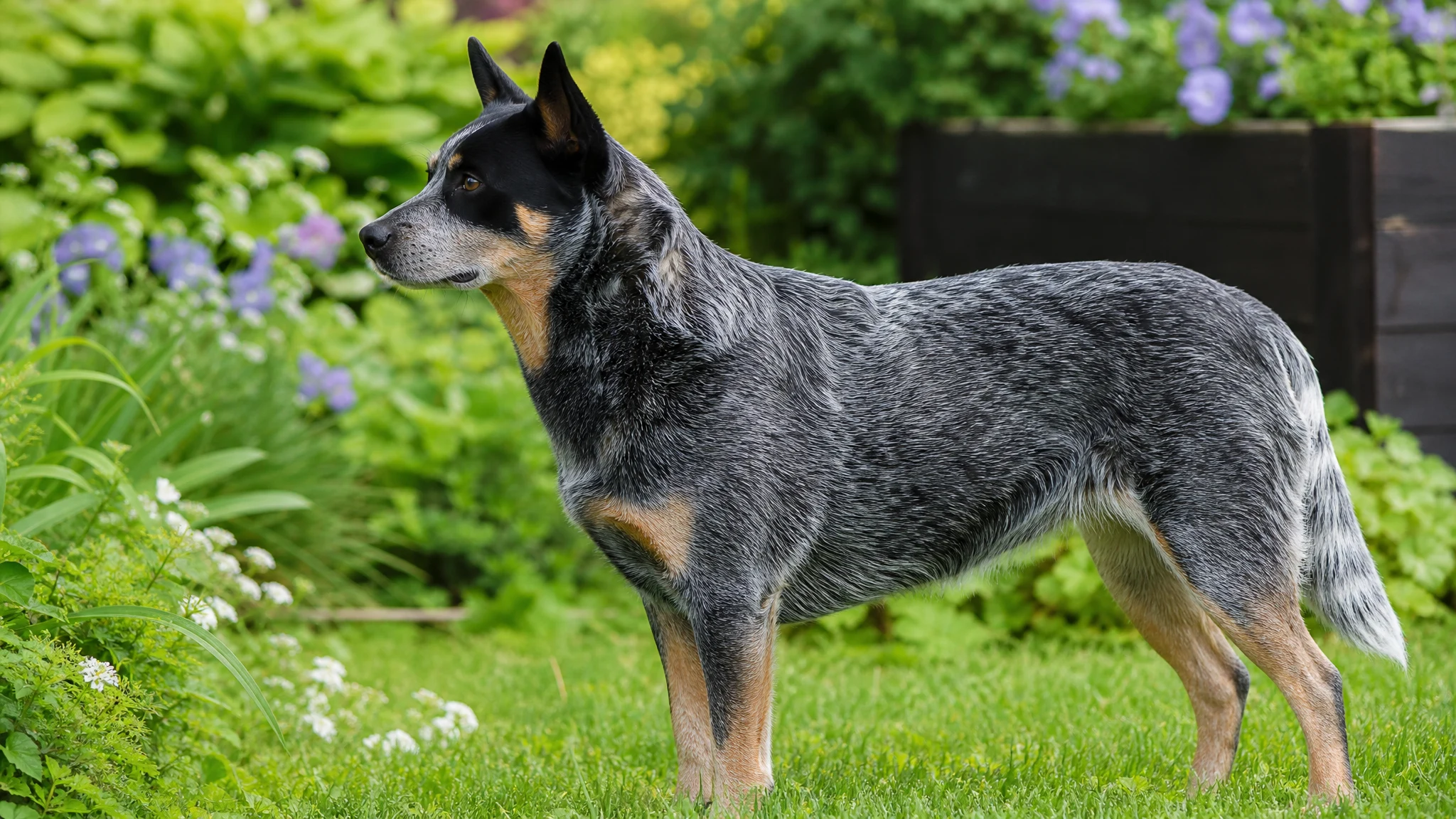
The Blue Heeler is registered as the Australian Cattle Dog. Blue Heeler is the common name, and this page uses both. Where a sourced number is missing, such as the exact age a Heeler counts as an adult, this guide says so and points you to your veterinarian or breeder instead of guessing.
What size will your Blue Heeler puppy be?
The MetLife Pet Insurance breed spotlight and the PetMD Australian Cattle Dog breed page both give an adult weight of 35 to 50 pounds. The Australian Cattle Dog Club of America (ACDCA) lists adult height at 18 to 20 inches for males and 17 to 19 inches for females, measured at the withers. It gives a life expectancy of about 12 to 16 years.
That makes the Blue Heeler a medium dog. AAFCO's large-breed cutoff is 70 pounds or more as an adult, so Heelers fall well under it. In practice, a puppy food does not have to be a large-breed formula for a Heeler.
Materials you need
- A complete and balanced puppy food with an AAFCO nutritional adequacy statement on the label.
- A kitchen scale. Royal Canin's own product page notes that grams are the most accurate way to measure a portion.
- A measuring cup, if you choose to feed by volume.
- A notebook or phone note to log weight, meals and treats.
- Your veterinarian's contact details for check-ups and weight checks.
- Small, soft treats you can count against the daily total.
Step 1: Understand the growth stages in feeding terms
AAFCO recognizes four life stages on pet food labels: gestation/lactation, growth, maintenance and all life stages, according to AAFCO's Reading Labels page. For a Heeler puppy, two matter: growth, then maintenance.
The sources we relied on do not give a month-by-month Heeler growth chart, and they do not state the age at which a Heeler is considered an adult. Your veterinarian can judge that from your own puppy's body condition and growth. Your breeder may also have a view based on the puppy's parents.
What the sources do say is that growth rate and calorie intake matter for bone and joint development in any growing dog. The IVC Journal article on feeding large breed puppies discusses developmental orthopedic disease in relation to growth rate. A steady, lean pace is the goal, not the fastest one.
Step 2: Read the AAFCO statement on the puppy food
AAFCO sets model language and does not approve or certify pet food, per AAFCO's Understanding Pet Food page. So a statement on a bag is the brand's claim that the food meets a standard, not an endorsement.
Look for one of these on the label:
- Formulated for growth, or for all life stages.
- For all life stages and growth foods, check the large-size clause. Whole Dog Journal explains that the wording "including growth of large-size dogs (70 pounds or more as an adult)" marks foods that meet large-breed puppy levels, while the "except for" version should not go to large-breed puppies. A Blue Heeler at 35 to 50 pounds is not in the large-size class, so either wording is a reasonable fit for this breed.
Step 3: Compare puppy foods by label data
We compared label data from the brand pages below. We did not run feeding trials or taste tests, and we have not fed any of these foods to a dog. Kibble size was not listed on any of these pages, so check with the brand if it matters for your puppy.
| Food | AAFCO statement (summary) | First ingredients | Protein / fat (min) | Energy |
|---|---|---|---|---|
| Royal Canin Size Health Nutrition Medium Puppy (dry) | Growth, including large size dogs | Chicken by-product meal, chicken fat, brewers rice, corn, wheat | 30.0% / 18.4% | 410 kcal ME per cup (calculated) |
| VICTOR Hi-Pro Plus Small & Medium Breed Puppy (dry) | All life stages, except growth of large size dogs | Beef, chicken, beef meal, chicken meal, whole grain sorghum | 30.0% / 18.0% | 383 kcal per cup |
| Hill's Science Diet Puppy Chicken & Barley Entree (13 oz can) | Growth and gestation/lactation, by animal feeding tests | Water, chicken, whole grain corn, cracked pearled barley, pork liver | Dry matter averages of 29% protein and 20.3% fat, not guaranteed minimums | 495 kcal per can (not per cup) |
A few things stand out from the labels. The two dry foods are close on protein and fat but differ in ingredients. The Hill's entree is a wet food, so its numbers are not directly comparable with the kibbles on a as-fed basis. Water makes up much of a canned food.
None of these is a Blue Heeler formula. No breed-specific Blue Heeler or Australian Cattle Dog food turned up in our research, so treat marketing that suggests otherwise with caution.
Step 4: Set a starting portion, then adjust
Use the feeding chart on the bag as a starting point, not a fixed prescription. Royal Canin's page calls its guide "only a guide" and the Hill's pages say to adjust amounts to maintain optimal weight. If you are unsure, ask your veterinarian.
Meal frequency varies by brand. VICTOR's puppy page suggests feeding what the puppy will eat in 20 minutes, across 4 feedings spaced through the day. Royal Canin's adult page suggests 2 to 4 equal portions per day. PetMD says adult Heelers typically eat 2 meals a day. For a young puppy, ask your vet which schedule suits your dog.
- Weigh your puppy and write the number down.
- Find the matching row on the label chart and split that amount into the number of meals the brand suggests.
- Weigh or measure each meal the same way every time.
- Re-weigh on a regular schedule and adjust with your veterinarian if the puppy is gaining too quickly or looks too thin.
Step 5: Avoid free-feeding and count the treats
Free-feeding means leaving food out all day. PetHealthMD's feeding guide says free-feeding puppies leads to excess weight gain that strains growing bones and joints. Measured meals let you see exactly how much your puppy eats.
Treats count too. PetMD warns that too many treats lead to overweight Heelers, although it does not list obesity as a breed predisposition. Training treats add up quickly with a smart, food-motivated herding breed. Take treat calories out of the daily meal amount, and use small pieces.
Step 6: Know the health topics that sit beside diet
Food is one part of raising a healthy puppy, and it does not treat or prevent any condition. Several health issues in the breed are inherited and are not managed by diet:
- Progressive retinal atrophy (PRA) is an inherited eye disease, screened with a DNA test, according to PetMD.
- Congenital deafness and primary lens luxation are inherited, and the ACDCA's OFA-CHIC requirements call for a BAER-based hearing evaluation and a lens luxation DNA test.
- Hip and elbow dysplasia are joint conditions. The ACDCA's CHIC requirements include hip and elbow evaluation. PetMD says hip dysplasia is uncommon in the breed.
Growth rate and healthy weight are the diet-related pieces for joints, which is why Steps 4 and 5 matter. A veterinarian decides what is right for an individual dog. For the wider picture, see our guide to Blue Heeler nutrition and the diet factors that matter.
Step 7: Plan the switch to adult food
Because no source we used gives a fixed age for adulthood in this breed, ask your veterinarian when to move your Heeler to a maintenance diet. Many brands offer an adult version of the same line, which can make the change simpler.
Hill's recommends changing foods gradually, mixing increasing amounts of the new food with decreasing amounts of the old over 7 days. Watch stools and appetite during the change, and call your vet if something seems off.
For reference, adult label data from the same brands looks like this:
- Royal Canin Size Health Nutrition Medium Adult (dry) lists 23.0% minimum protein, 12.0% minimum fat and 340 kcal ME per cup.
- VICTOR Hi-Pro Plus lists 30.0% minimum protein, 20.0% minimum fat and 406 kcal per cup, and the brand describes it as a high-energy food for active dogs.
PetMD says calorically dense, high-quality diets may be ideal for this active breed, and that amounts should follow the bag guidance and the dog's ideal weight. A denser food means a smaller portion, so recheck the chart when you switch.
Tips
- Keep one food for the whole growth period unless your vet advises a change.
- Use the same scale or cup every time so portions stay consistent.
- Ask the breeder what the puppy was eating before you brought it home.
- Take the puppy's body condition notes to each vet visit.
Common mistakes to avoid
- Buying a large-breed puppy formula because puppies grow fast. A 35 to 50 pound dog is below AAFCO's 70 pound cutoff.
- Feeding by eye and letting portions drift upward.
- Forgetting that training treats and chews add calories.
- Switching foods suddenly.
- Treating a food label as proof of a health benefit. Label claims describe nutrient levels, not outcomes.
- Reading too much into the DCM headlines. The FDA's page on diet and canine dilated cardiomyopathy was last updated December 23, 2022. It describes the link as a complex scientific issue that is not resolved, and says adverse event reports alone do not establish cause. Ask your veterinarian about it for your own dog.
Expected results
With measured meals, a complete and balanced growth food and regular weight checks, many owners find their puppy grows at a steady pace and keeps a lean, athletic shape. Results vary from dog to dog, and no food can promise a particular outcome. Genetics, exercise and health care all play a part.
If your puppy seems too thin, too heavy, low on energy or has stool changes that persist, contact your veterinarian rather than adjusting on your own.
Sources
- PetMD, Australian Cattle Dog breed page
- Australian Cattle Dog Club of America, Your New Australian Cattle Dog
- Australian Cattle Dog Club of America, OFA-CHIC Health Testing Requirements
- MetLife Pet Insurance, Australian Cattle Dog breed spotlight
- AAFCO, Understanding Pet Food
- AAFCO, Reading Labels
- Whole Dog Journal, In the Fine Print: Nutritional Adequacy Statements
- IVC Journal, Feeding large breed puppies
- PetHealthMD, Feeding Your Large Breed Puppy
- FDA CVM, Investigation into Potential Link between Certain Diets and Canine Dilated Cardiomyopathy
- Royal Canin, Medium Puppy product page
- VICTOR, Hi-Pro Plus Small & Medium Breed Puppy product page
- Hill's Pet Nutrition, Science Diet Puppy Chicken & Barley Entree product page