Best Puppy Food Types Explained: Dry, Wet and Fresh
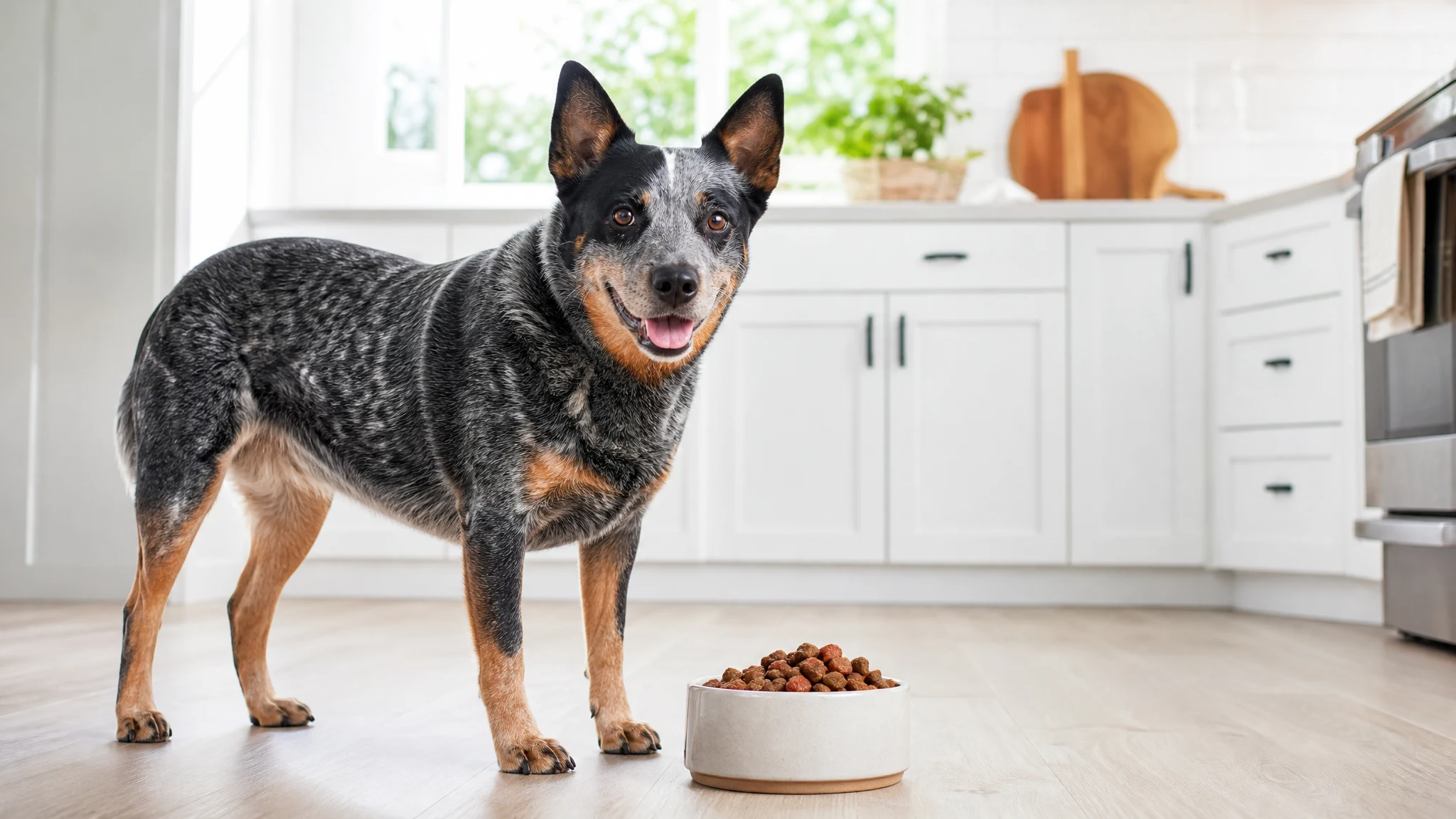
General nutrition information compiled from product labels and published sources, not veterinary advice. Your veterinarian is the right person to choose a diet for your dog, especially one with a health condition.
Choosing a food for a Blue Heeler puppy comes down to two questions. Which form fits your household, and does the label say the food is complete for growth? This guide walks through both, one step at a time.
Blue Heeler is the common name for the Australian Cattle Dog. We compared label data from brand pages. We did not run feeding trials or taste tests, and nothing here says one food is better for your puppy than another.
What you need before you start
- The bag, can or package of any food you are considering, or its brand page open on screen.
- Your puppy's current age and weight from your veterinarian's scale.
- A notebook for comparing the AAFCO statement, protein, fat and calories.
- A kitchen scale, if you want to measure portions by weight.
- Your veterinarian's contact details, because they decide what is right for an individual puppy.
Step 1: Know your puppy's size class
PetMD and MetLife Pet Insurance both list the adult Blue Heeler at 35 to 50 lb. The Australian Cattle Dog Club of America gives adult height as 18 to 20 inches for males and 17 to 19 inches for females. That makes the breed medium sized.
AAFCO treats a large breed as one expected to weigh 70 lb or more as an adult. A Blue Heeler falls below that line, so a large-breed puppy formula is not required. A food that carries the large-size wording is not a problem either.
Step 2: Read the AAFCO statement first
AAFCO, the Association of American Feed Control Officials, sets model language for pet food. It says AAFCO does not approve or certify pet food. The statement on the label is the brand's own claim about nutritional adequacy.
AAFCO recognizes four life stages: gestation/lactation, growth, maintenance and all life stages. For a puppy, look for growth or all life stages. A maintenance-only statement describes an adult food.
Some statements end with "except for growth of large size dogs (70 lb or more as an adult)." Whole Dog Journal explains that foods with this wording should not be fed to large-breed puppies. Since Blue Heelers are not in that class, the wording does not rule a food out for them.
Step 3: Compare the three food types
Dry food
Dry food is shelf-stable and easy to measure. It is also the easiest form to use as a training reward, since a few pieces can come straight from the day's portion. The label lists guaranteed minimums for protein and fat, which makes side-by-side comparison simple.
Wet food
Wet food is mostly water, so its calories per can are spread over more volume. Hill's gives calories per can rather than per cup. You cannot compare it directly with a dry food's per-cup figure. You can convert both to calories per day, or ask your veterinarian to help.
Fresh food
Fresh food is sold refrigerated as a roll that you slice. Freshpet's pages describe cutting it into 1-inch cubes or smaller. Its protein and fat percentages look low next to dry food because of the moisture. Compare these on a dry-matter basis only if the brand provides that data.
Step 4: Compare the label data
The table uses figures from each brand's own page. "Not listed" means the page gave no guaranteed minimum, so check the label or ask the brand.
| Food | Form | AAFCO statement | Protein min / fat min | Calories | First ingredients |
|---|---|---|---|---|---|
| Royal Canin Size Health Nutrition Medium Puppy | Dry | Growth, including large size dogs | 30% / 18.4% | 410 kcal ME per cup | Chicken by-product meal, chicken fat, brewers rice, corn, wheat |
| VICTOR Hi-Pro Plus Small & Medium Breed Puppy | Dry | All life stages, except large size dog growth | 30% / 18% | 383 kcal per cup | Beef, chicken, beef meal, chicken meal, whole grain sorghum |
| Hill's Science Diet Puppy Chicken & Barley Entree (13 oz can) | Wet | Growth and gestation/lactation, by feeding tests | Not listed (dry matter averages 29% / 20.3%) | 495 kcal per can | Water, chicken, whole grain corn, cracked pearled barley, pork liver |
| Freshpet Tender Chicken Recipe with Carrots, Peas & Brown Rice | Fresh | Adult maintenance | 9.5% / 7% | About 316 kcal per 1/2 lb | Chicken, carrots, chicken broth, peas, eggs |
Three things stand out from the table.
- The Freshpet recipe carries an adult maintenance statement. The brand page we reviewed does not list a growth or all-life-stages statement for it. If you want fresh food for a puppy, ask Freshpet whether it makes a growth recipe, and ask your veterinarian before you feed it.
- The Hill's wet puppy food gives dry matter averages rather than guaranteed minimums. Do not compare those numbers directly with the dry foods' minimums.
- Calories are quoted per cup, per can and per half pound. Convert to a daily total before you compare.
The pages we used did not list kibble size for any of these foods. If kibble size matters for a small puppy, check with the brand.
Step 5: Check the first ingredients, with perspective
Ingredients are listed by weight before cooking. Water-rich ingredients such as fresh chicken or broth weigh a lot on the scale and can sit high on the list. Meals and by-product meals are concentrated and can sit lower while still contributing a lot of protein.
The ingredient list tells you what is in the food. It does not tell you how it performs for your puppy. Treat claims about "real meat first" as marketing until you have read the whole panel.
Step 6: Think about the breed's health context
The Australian Cattle Dog Club of America's health testing requirements include hip and elbow evaluation, because hip and elbow dysplasia can affect the breed. PetMD says hip dysplasia is uncommon in Heelers. Other inherited conditions listed there and by the club, such as progressive retinal atrophy, deafness and primary lens luxation, are not diet related.
No food on this page prevents or treats any of these. For any growing dog, the IVC Journal notes that growth rate and calorie intake matter for developmental orthopedic disease. Free-feeding is discouraged for that reason. Your veterinarian can tell you whether your puppy's growth is on track.
Step 7: Set the portion
Use the label's feeding guide as a starting point and adjust with your veterinarian. Guides vary. Royal Canin's adult page suggests 2 to 4 equal portions per day and says grams are the most accurate way to measure. VICTOR's puppy page describes feeding as much as the puppy will eat in 20 minutes, four times a day. That is a different approach from measured portions. Ask your veterinarian which suits your puppy.
For age-based guidance, see our Blue Heeler feeding chart by age.
Step 8: Switch foods gradually
Hill's suggests mixing increasing amounts of the new food with decreasing amounts of the old food over 7 days. Move slowly if your puppy's stool changes. Call your veterinarian if loose stools or vomiting continue.
Tips
- Pick one food and stay with it for a few weeks before judging it. Changing every few days makes it hard to tell what is working.
- Count treats toward the daily total. PetMD warns that too many treats lead to overweight Heelers.
- PetMD calls the breed active and says calorically dense, high-quality diets may suit it. It also says two feedings a day are typical. Your veterinarian can say whether that applies to your puppy.
- Mixing forms, such as dry food with a spoonful of wet food, is common. Count the calories from both.
- Use pieces of the daily kibble portion for reward-based training. It keeps the total in check.
Common mistakes to avoid
- Feeding an adult maintenance food to a growing puppy because the package looks appealing.
- Comparing a wet food's calories per can with a dry food's calories per cup.
- Assuming a large-breed puppy formula is required. For a 35 to 50 lb breed, it is not.
- Reading the grain-free label as a health claim. The FDA's investigation into diet and canine dilated cardiomyopathy (DCM) has had no public update since December 23, 2022. FDA describes the link as a complex scientific issue that is not resolved, and says adverse event reports alone do not establish cause. Ask your veterinarian about it.
- Adding supplements without asking your veterinarian first.
- Leaving food out all day. Free-feeding can lead to excess weight gain in puppies.
What to expect
A puppy eating a complete and balanced food in sensible portions may show steady growth, a healthy body condition and normal stools. Results vary from puppy to puppy. A food that looks good on paper may still not suit your dog.
Your veterinarian can check weight and body condition at each visit. If the puppy seems too thin or too heavy, adjust portions with their guidance rather than by guesswork.
Sources
- AAFCO, Understanding Pet Food
- AAFCO, Reading Labels
- Whole Dog Journal, In the Fine Print: Nutritional Adequacy Statements
- PetMD, Australian Cattle Dog breed page
- Australian Cattle Dog Club of America, Your New Australian Cattle Dog
- Australian Cattle Dog Club of America, OFA-CHIC Health Testing Requirements
- IVC Journal, Feeding large breed puppies
- FDA CVM, Investigation into Potential Link between Certain Diets and Canine DCM
- Royal Canin, Medium Puppy product page
- Hill's Pet Nutrition, Puppy Chicken & Barley Entree product page
- VICTOR Pet Food, Hi-Pro Plus Small & Medium Breed Puppy product page
- Freshpet, Tender Chicken Recipe product page