Blue Heeler Puppies: A Complete First-Year Feeding Timeline
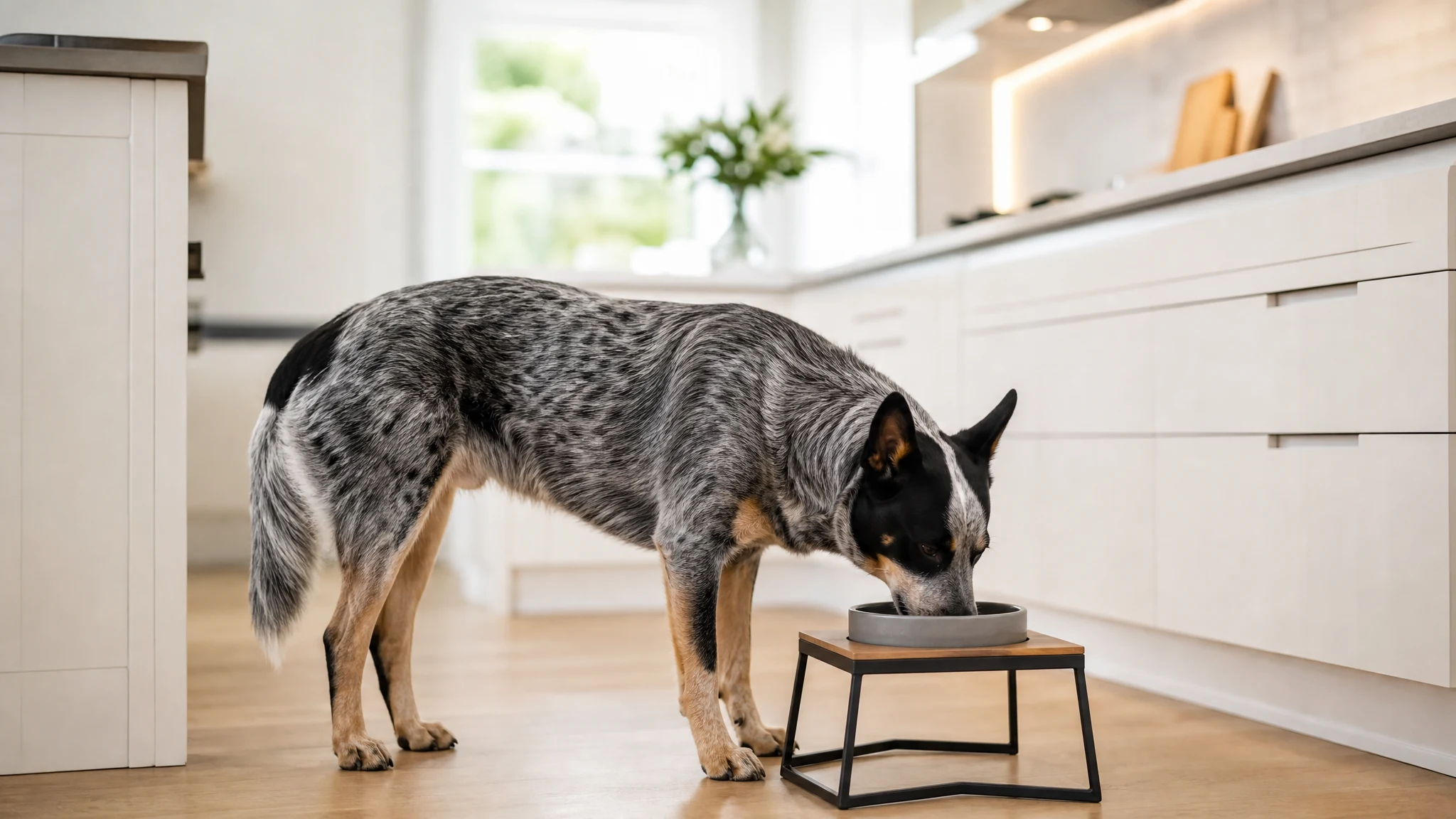
General nutrition information compiled from product labels and published sources, not veterinary advice. Your veterinarian is the right person to choose a diet for your dog, especially one with a health condition.
A Blue Heeler puppy grows fast, and the bag of food is the one thing you control every day. This guide walks through the first year in order: what to gather, how to read a puppy food label, how to set up meals, and when to change things.
One note on names. "Blue Heeler" is the common name for the Australian Cattle Dog, which is the official breed name used by PetMD and the Australian Cattle Dog Club of America (ACDCA).
We compared label data from brand pages. We did not run feeding trials or taste tests, and nothing here replaces your veterinarian's advice for your own puppy.
What You Need Before You Start
- A complete and balanced puppy food (or an all life stages food) with an AAFCO statement on the label.
- A kitchen scale or a level measuring cup. The Royal Canin Medium Adult page notes that grams are the most accurate way to measure, and that applies to puppy portions too.
- A set feeding spot and a clean water bowl.
- A notebook or phone note for weight, portions and treats.
- Your veterinarian's contact details, since they decide what is right for an individual puppy.
Know the Size You Are Feeding For
Both PetMD and MetLife Pet Insurance list adult Blue Heeler weight at 35 to 50 lb. The ACDCA gives height as 18 to 20 inches for males and 17 to 19 inches for females. That makes the breed medium sized.
AAFCO treats a large breed as one expected to weigh more than 70 lb fully grown, according to PetHealthMD. So a Blue Heeler is not in the large-size class, and a large-breed puppy formula is not required.
Growth still matters for a medium dog. The IVC Journal notes that growth rate and calorie intake affect developmental orthopedic disease in any growing dog. The ACDCA's health testing requirements include hip and elbow evaluation for the breed, so steady growth is worth taking seriously.
Step 1: Read the Puppy Food Label
Start with the nutritional adequacy statement. AAFCO recognizes four life stages: gestation/lactation, growth, maintenance and all life stages. AAFCO also says it sets model language and does not approve or certify pet food. The statement is the brand's own claim of how it meets the profiles.
You will see two versions of the wording on growth and all life stages foods:
- "Including growth of large-size dogs (70 pounds or more as an adult)" means the food meets large-breed puppy levels, according to Whole Dog Journal. Royal Canin Medium Puppy uses this wording.
- "Except for growth of large-size dogs" means the food should not be fed to large-breed puppies. VICTOR Hi-Pro Plus Small & Medium Breed Puppy uses this wording. A Blue Heeler is not in the large-size class, so this version is not a problem for the breed.
Then check the first ingredients, the guaranteed analysis and the calories per cup. Here is how a few puppy options compare on label data from each brand's own page:
| Food | Form | First ingredients | Protein min / fat min | Calories |
|---|---|---|---|---|
| Royal Canin Size Health Nutrition Medium Puppy | Dry | Chicken by-product meal, chicken fat, brewers rice, corn, wheat | 30.0% / 18.4% | 410 kcal ME per cup |
| VICTOR Hi-Pro Plus Small & Medium Breed Puppy | Dry | Beef, chicken, beef meal, chicken meal, whole grain sorghum | 30.0% / 18.0% | 383 kcal per cup |
| Hill's Science Diet Puppy Chicken & Barley Entree | Wet | Water, chicken, whole grain corn, cracked pearled barley, pork liver | Not given as minimums (dry matter averages: 29 protein, 20.3 fat) | 495 kcal per 13 oz can |
Kibble size is not listed on these pages, so check with the brand if your puppy struggles with the pieces. Wet food is measured per can, not per cup, so its calories cannot be compared directly with kibble.
The Hill's wet puppy food states it is substantiated by AAFCO feeding tests. The two dry foods state they are formulated to meet AAFCO nutrient profiles. Those are different routes to the same kind of statement, and the label tells you which one applies.
Step 2: Set the Meal Schedule
The brand page for VICTOR's small and medium breed puppy food describes feeding as much as the puppy will eat in 20 minutes, in four feeding intervals spaced through the day. Royal Canin's medium adult page recommends 2 to 4 equal portions per day. PetMD says adult Heelers typically eat twice a day.
Put together, a reasonable pattern is several small meals for a young puppy, then fewer, larger meals as the puppy matures. Exact ages for each change are a call for your veterinarian, who can see your puppy.
Free-feeding is discouraged. PetHealthMD says it leads to excess weight gain that strains growing bones and joints. Set meal times, pick up the bowl after the meal, and keep a record.
Step 3: Start From the Label Guide, Then Adjust
Every bag or brand page gives a feeding guide. Treat it as a starting point. Royal Canin says its guide is only a guide, and its puppy page asks for your pet's details to calculate a tailored recommendation. Hill's says to adjust amounts as necessary to maintain optimal weight and to ask your veterinarian if you are unsure.
PetMD says amounts should follow the bag guidance and the dog's ideal weight. For a ballpark of portions by age, see our Blue Heeler feeding chart by age, and confirm the numbers against your own food's label.
The First-Year Timeline
No source we relied on gives a month-by-month portion table for this breed, and the age at which a Blue Heeler counts as an adult is not stated. So treat the stages below as a general order of events, not exact ages.
Early Weeks at Home
- Ask the breeder or rescue what the puppy has been eating, and buy the same food at first.
- Feed several small meals a day from the label guide, at the same times each day.
- Weigh the puppy on a regular schedule and write it down.
Growth Months
- Keep meals scheduled. Recheck the label guide against the new weight as the puppy grows.
- Use part of the daily portion for training treats, so the total stays steady.
- Ask your veterinarian at each checkup whether the body condition looks right and whether the meal count should drop.
Approaching Adulthood
- Talk with your veterinarian about when to move to an adult food. PetMD notes that Heelers are active and that calorically dense, high-quality diets may be ideal.
- Switch gradually. Hill's recommends mixing increasing amounts of the new food with decreasing amounts of the old over 7 days.
- Adult options with a maintenance statement include Royal Canin Medium Adult (340 kcal ME per cup) and Hill's Science Diet Adult Perfect Digestion Chicken & Barley (368 kcal per cup). Both are listed on the brands' own pages.
Step 4: Handle Treats and Extras
PetMD warns that excess treats lead to overweight Heelers. It does not list obesity as a breed predisposition, but the warning is worth following. Count treats as part of the day's food.
Do not add supplements on your own. If you think your puppy needs one, ask your veterinarian, who decides whether it is appropriate and how much to give.
Step 5: Make Food Changes Slowly
Any change in brand, formula or form should be gradual. Use the 7-day mix described above and watch the stool and appetite. If your puppy has a poor appetite, vomiting or loose stools that continue, call your veterinarian.
Tips
- Compare calories per cup before comparing brands. A 410 kcal cup and a 383 kcal cup are not the same amount of food.
- Measure by weight or with a level cup, not by eye.
- Keep the same food through big changes such as a move or travel, when you can.
- Take your feeding notes to checkups.
Common Mistakes to Avoid
- Buying a large-breed puppy formula by default. A Blue Heeler's adult weight is below the 70 lb cutoff, so it is not required.
- Free-feeding. It makes portions impossible to track.
- Ignoring treat calories. Small extras add up in a medium dog.
- Copying a feeding amount from another dog. Use your own food's label and your puppy's weight.
- Switching foods in a day. Use the gradual mix.
A Note on DCM and Grain-Free Labels
The FDA's investigation into diet and canine dilated cardiomyopathy (DCM) has not been resolved. The FDA describes the association as a complex scientific issue. Its latest update is dated December 23, 2022, and it says it will not issue further public updates until there is meaningful new scientific information. It also says adverse event reports alone do not establish cause.
That is a reason to talk with your veterinarian about the choice, not a reason to panic over any one label.
What to Expect
With measured portions, a steady schedule and regular weigh-ins, many owners find their puppy's growth easier to follow and adjust. A food that suits your puppy may be reflected in steady energy, good appetite and normal stools, though individual dogs vary.
No food prevents or treats hip dysplasia, eye disease or other inherited conditions. The ACDCA lists those as matters for health testing and breeding, and your veterinarian decides what is right for an individual dog. If your puppy has a health condition, confirm all amounts with your veterinarian before changing anything.
Sources
- PetMD, Australian Cattle Dog breed page
- Australian Cattle Dog Club of America, Your New Australian Cattle Dog
- Australian Cattle Dog Club of America, OFA-CHIC Health Testing Requirements
- MetLife Pet Insurance, Australian Cattle Dog breed spotlight
- AAFCO, Understanding Pet Food
- AAFCO, Reading Labels
- Whole Dog Journal, In the Fine Print: Nutritional Adequacy Statements
- IVC Journal, Feeding large breed puppies
- PetHealthMD, Feeding Your Large Breed Puppy
- FDA CVM, Investigation into Potential Link between Certain Diets and Canine Dilated Cardiomyopathy
- Royal Canin, Medium Puppy product page
- Royal Canin, Medium Adult product page
- VICTOR, Hi-Pro Plus Small & Medium Breed Puppy product page
- Hill's Pet Nutrition, Puppy Chicken & Barley Entree product page
- Hill's Pet Nutrition, Adult Perfect Digestion product page