Texas Heeler Size, Temperament and Feeding Needs
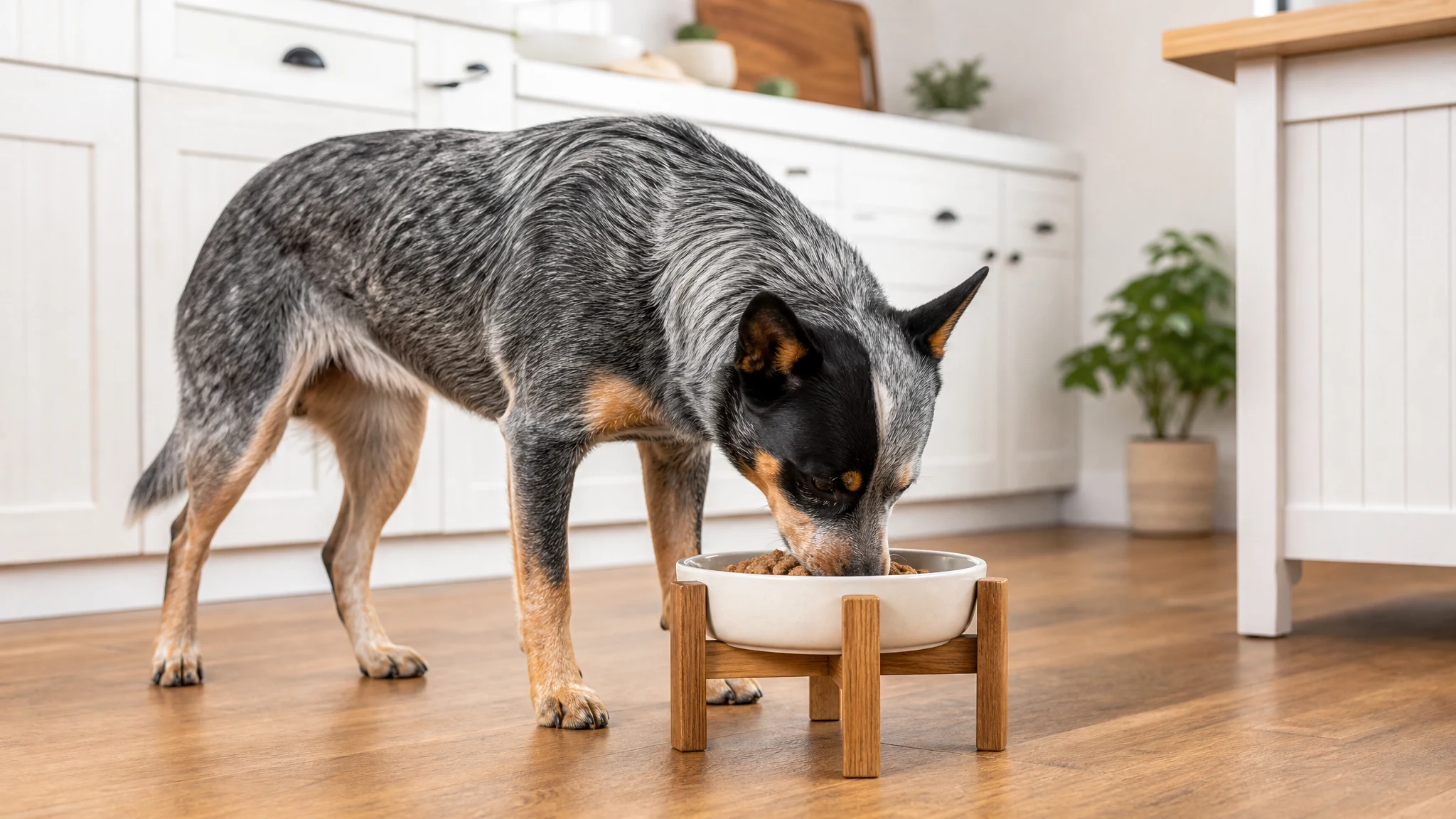
General nutrition information compiled from product labels and published sources, not veterinary advice. Your veterinarian is the right person to choose a diet for your dog, especially one with a health condition.
"Texas Heeler" is a name people commonly use for a mixed dog with a Blue Heeler in the family tree. Because it is a mix, no single number fits every dog. The Blue Heeler (officially the Australian Cattle Dog) is the part we can describe with sources, so this guide uses it as the baseline.
Below you will find a simple routine for estimating size, planning around an active working-breed dog, and setting up feeding. Where a mix could differ, the guide says so and points you to your veterinarian, breeder or rescue.
What you need before you start
- A kitchen scale or a gram-accurate scoop for portions
- The bag or can of your current food, with its label and feeding guide
- A notebook or phone note for weight, meals and treats
- Your dog's recent weight from a veterinary visit
- Any information from the breeder or rescue about the dog's parents
Step 1: Estimate adult size from the Blue Heeler baseline
PetMD and MetLife Pet Insurance both list the adult weight of an Australian Cattle Dog at 35 to 50 lb. The Australian Cattle Dog Club of America gives height at the withers as 18 to 20 inches for males and 17 to 19 inches for females. That makes the breed medium-sized.
A Heeler mix may land above or below those ranges, depending on the other parent. Ask the breeder or rescue what they know about both parents, and ask your vet to track growth at each visit. Treat the ranges above as a starting guess, not a promise.
Step 2: Plan around an active, working-type dog
PetMD describes the Australian Cattle Dog as an active breed. For that reason it says a calorically dense, high-quality diet may be ideal, typically fed in two meals per day. It also says amounts should follow the bag guidance and the dog's ideal weight.
We have no source describing the temperament of a Texas Heeler mix specifically. If your dog is high-energy, expect the same practical needs as a Heeler: regular exercise, mental work and measured meals. Reward-based training fits well here, and food rewards should be counted in the daily total (see Step 6).
Step 3: Match the food to your dog's life stage
AAFCO recognizes four life stages: gestation/lactation, growth, maintenance and all life stages. AAFCO also says it sets model language and does not approve or certify pet food, so the statement on the label is the manufacturer's claim, not an AAFCO seal.
For puppies, look for a growth or all-life-stages statement. At 35 to 50 lb, an adult Heeler falls below AAFCO's large-size cutoff of 70 lb as an adult. The Whole Dog Journal explains that some labels say "including growth of large-size dogs" while others say "except for growth of large-size dogs." A Heeler is not in the large-size class, so either wording is not a problem on size grounds. A mix with a much larger parent could be different, so ask your vet if you are unsure.
The IVC Journal notes that growth rate and calories matter for developmental orthopedic disease in any growing dog. Free-feeding puppies is discouraged. PetHealthMD says it leads to excess weight gain that strains growing bones and joints.
Step 4: Read the label, not the front of the bag
Compare these items, in this order:
- The AAFCO statement and the life stage it covers
- Calories per cup (or per can), so you can compare foods fairly
- The first five ingredients
- Guaranteed analysis for protein, fat and fiber
To show how this works, here is label data from the brands' own pages. We compared label data only. We did not run feeding trials or taste tests, and kibble size is not listed on these pages.
| Food | Life stage on label | Calories | First ingredients |
|---|---|---|---|
| Royal Canin Size Health Nutrition Medium Adult (dry) | Adult maintenance | 340 kcal ME per cup | Brewers rice, chicken by-product meal, oat groats |
| Royal Canin Size Health Nutrition Medium Puppy (dry) | Growth, including large-size dogs | 410 kcal ME per cup | Chicken by-product meal, chicken fat, brewers rice |
| Hill's Science Diet Adult Perfect Digestion Chicken & Barley | Adult maintenance | 368 kcal per cup | Chicken, cracked pearled barley, brown rice |
| VICTOR Hi-Pro Plus | All life stages except growth of large-size dogs | 406 kcal per cup | Beef meal, grain sorghum, chicken fat |
| VICTOR Hi-Pro Plus Small & Medium Breed Puppy | Puppy, all life stages except growth of large-size dogs | 383 kcal per cup | Beef, chicken, beef meal |
The guaranteed minimums also differ. Royal Canin Medium Adult lists 23 percent protein and 12 percent fat. VICTOR Hi-Pro Plus lists 30 percent protein and 20 percent fat. A higher-calorie food means a smaller portion for the same energy, which matters for a dog that gains weight easily.
None of these is a Blue Heeler or Australian Cattle Dog formula. We found no breed-specific formula, and none is needed. Hill's lists its numbers as dry matter averages rather than guaranteed minimums, so do not compare its protein and fat directly to the others.
Step 5: Start from the label's feeding guide
Use the guide on your food as a starting point, based on your dog's current or ideal weight. Royal Canin calls its guide "only a guide" and notes that grams are the most accurate way to measure. Hill's says to adjust amounts as necessary to maintain optimal weight and to ask your veterinarian if you are unsure.
Split the daily amount into two meals, in line with PetMD's note about typical feeding for the breed. For a puppy, ask your vet whether to use more meals. VICTOR's small and medium breed puppy page, for example, describes four feedings a day.
For a month-by-month look at portions, see our guide on how much to feed a Blue Heeler by age.
Step 6: Count the treats
PetMD warns that too many treats can make a Heeler overweight. It does not list obesity as a breed predisposition, so this is a habit issue, not a destiny. Reward-based training uses a lot of treats, so plan for it:
- Use part of the daily kibble as training rewards
- Keep treats small
- Write down extras so they are not forgotten
Step 7: Check weight and adjust gradually
Weigh your dog on a regular schedule and note it. If weight creeps up or down, change portions in small steps and recheck. Your vet can show you how to judge body condition by feel and by sight.
Joint health is worth raising with your vet. The Australian Cattle Dog Club of America lists hip and elbow evaluation in its health testing requirements, and these conditions relate to growth rate and healthy weight. PetMD says hip dysplasia is uncommon in the breed. A veterinarian decides what is right for an individual dog, including whether any supplement or special diet makes sense.
Step 8: Switch foods slowly
If you change foods, Hill's suggests mixing increasing amounts of the new food with decreasing amounts of the old over 7 days. Keep the same total calories during the switch.
Common mistakes to avoid
- Free-feeding a puppy. Measured meals make growth easier to manage.
- Choosing a large-breed puppy food by default. A Heeler's adult weight is below AAFCO's 70 lb cutoff. Match the food to your own dog's expected size.
- Comparing foods by price or front-label claims. Compare AAFCO statements and calories per cup instead.
- Ignoring treats. They count toward the daily total.
- Assuming a mix matches the breed standard. Size and energy level can vary.
- Making health-based diet changes alone. Prescription diets come only from a veterinarian.
About grain-free and DCM
You may see grain-free foods marketed to Heeler owners. The FDA's investigation into diet and canine dilated cardiomyopathy (DCM) has not been updated since December 23, 2022. The FDA describes the link as a complex scientific issue that is not resolved, and says adverse event reports alone do not establish cause. If you have questions about your dog's heart or diet, ask your vet.
What to expect
With measured meals, a life-stage-appropriate food and regular weigh-ins, many owners find it easier to keep a Heeler or Heeler mix at a steady, healthy weight. Results vary by dog, and a good routine does not prevent or treat any disease. If your dog has a health condition, confirm amounts and food choice with your veterinarian. Brand pages can change, so check the current label before you buy.
Sources
- PetMD, Australian Cattle Dog breed page
- Australian Cattle Dog Club of America, Your New Australian Cattle Dog
- Australian Cattle Dog Club of America, OFA-CHIC Health Testing Requirements
- MetLife Pet Insurance, Australian Cattle Dog breed spotlight
- AAFCO, Understanding Pet Food
- AAFCO, Reading Labels
- Whole Dog Journal, In the Fine Print: Nutritional Adequacy Statements
- IVC Journal, Feeding large breed puppies
- PetHealthMD, Feeding Your Large Breed Puppy
- FDA CVM, Investigation into Potential Link between Certain Diets and Canine DCM
- Royal Canin, Medium Adult product page
- Hill's Pet Nutrition, Adult Perfect Digestion product page
- VICTOR Pet Food, Hi-Pro Plus product page